Two options on the product page. NZ$109.99 for two cards, NZ$139.99 for three. Nothing on the box explains what the third one does, so a lot of people pick the cheaper one and move on.
The answer up front: get the 3-card set. Choosing between the Tangem Wallet 2-card vs 3-card set comes down to one question, which is what position you are in after your first loss. Thirty dollars is a small price for the difference. What follows is why, plus where the cards should go once they arrive.
Tangem 2-card vs 3-card set
The short answer
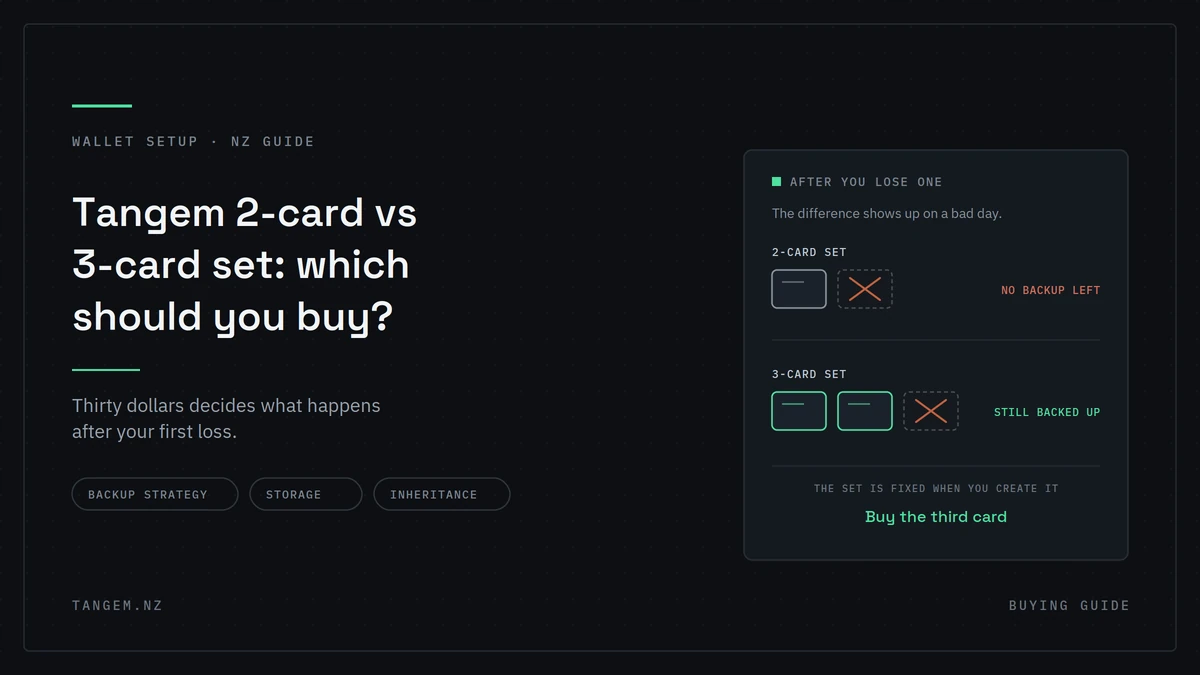
Buy the 3-card set. The extra card costs about NZ$30 and it is the difference between having a backup and having a spare. With two cards, losing one leaves you with a single point of failure. With three, you lose one and you are still properly backed up.
What each card actually is
Every card in a Tangem set holds the same private key and gives identical access to the same wallet. There is no primary card and no secondary cards. They are equal copies, like three keys cut for the same door.
That is worth understanding before you decide where to put them.
Why that matters for storage
Each card is full access to your funds. It is not a recovery tool that needs something else to work, and not a partial key. On its own, with the access code, it opens the wallet.
So a card left in a drawer is a wallet left in a drawer. Anyone who finds it and knows your access code can move your crypto. That is why the storage advice later in this article matters as much as which set you buy.
What a set is not
- Not multiple wallets. Three cards, one wallet, one balance.
- Not multisig. No card needs another card’s approval. Any one of them works alone.
- Not something to lend. Handing someone a card is handing them your wallet.
If the seedless model is new to you, our explanation of how seedless wallets work covers why the backup is hardware rather than a written phrase.
The real difference is what happens after your first loss
This is the whole argument, and it isn’t about how many cards you own on day one. It is about the position you are in the day after something goes wrong.
With two cards
You lose a card. A house fire, a burglary, a move where a box vanished, or you simply can’t find it. You still have access, so nothing is lost. But you are now running on a single card with no backup at all.
Every risk from that point is total. Lose the remaining card and the wallet is gone for good. You would need to set up a replacement quickly, and “quickly” isn’t how most people handle admin after a fire or a burglary.
With three cards
Same loss, different position. You still have two cards in separate places. Nothing urgent, no scramble, no window of exposure. You move funds to a fresh set when you get around to it, if you are worried about who has the missing card, and otherwise carry on.
That is the difference between a bad afternoon and a real problem.
Why “I’ll be careful” isn’t a plan
Loss usually isn’t carelessness. It is a house fire, the 2023 Auckland floods, a burglary while you are away, a move where a box doesn’t arrive, or a relative tidying a drawer they thought was full of old loyalty cards.
Careful people lose things to events, not to mistakes. The backup exists for the events.
The storage plan a third card makes possible
Two cards give you two locations. Three give you a spread that can survive a regional event, and in New Zealand geography matters more than most people account for.
Two cards: home and one other place
Realistically that is your house plus a workplace, a family member’s home, or a safe deposit box. It works, provided those two places aren’t exposed to the same event.
The failure mode is proximity. Your house and your parents’ house three streets away are one flood, one earthquake, one storm from being the same location.
Three cards: home, off-site, and somewhere unrelated
The third card lets you do something the second can’t: put a copy somewhere that shares none of the same risks.
- Card one at home, in daily use
- Card two in a different building nearby, for convenience
- Card three in a different city, a lawyer’s office, a safe deposit box, or with a family member elsewhere in the country
That third location is the one that survives a regional event.
New Zealand-specific risks
We live with earthquakes, floods and storms, and they don’t hit single houses. They hit suburbs and regions. Christchurch, Kaikōura, the Auckland floods and Cyclone Gabrielle each displaced large numbers of people from whole areas at once.
Two cards in the same suburb is one event away from zero. That is the case for spreading them further than feels necessary.
Places that seem safe but aren’t
- A single fireproof box. It protects against fire and does nothing about flood, theft, or losing the box.
- The car glovebox. Cars get stolen, broken into and sold.
- The same drawer as your phone. A burglar taking the phone takes the card too.
- A work desk. You may leave that job faster than you expect.
- A clever hiding place you will forget. This happens more often than you would think.
The argument nobody makes: inheritance
Self-custody has a failure mode almost nobody plans for. If something happens to you tomorrow, does anyone else know the wallet exists, where the cards are, or what to do with them?
For a lot of people the honest answer is no, and that means the crypto is simply gone.
How a third card helps
The third card can live with your executor, your lawyer, in a safe deposit box named in your will, or with a family member who knows what it is. It is the only card you can spare for the purpose, which is exactly why the 2-card set makes this awkward.
What that person needs to know
At minimum: that the card exists, what it is, and that it is valuable. Ideally, how to install the app and tap the card.
The access code is the sensitive part. Some people leave it with a lawyer separately from the card; some put instructions in a sealed document with their will. What matters is that the two pieces aren’t lost together and aren’t held casually together either.
The caveat
Anyone holding a card and knowing the access code has full access to your funds while you are alive, too. Choose that person carefully, and consider whether they should hold the card while someone else holds the code.
Side by side
| 2-card set | 3-card set | |
|---|---|---|
| Price (NZ$ incl. GST) | $109.99 | $139.99 |
| Cards | 2 | 3 |
| Access to wallet | Identical from either | Identical from any |
| After losing one card | No backup remaining | Still fully backed up |
| Storage locations possible | 2 | 3 |
| Suits inheritance planning | Awkward, no spare card | Yes |
| Best for | Small holdings, testing the model | Almost everyone |
When the 2-card set is fine
It isn’t a bad product, and there are situations where it is the right call:
- Small holdings you would be annoyed rather than devastated to lose
- A first wallet, where you are testing whether self-custody suits you
- A tight budget where NZ$30 matters right now
- A living situation where two locations is honestly all you have
One important caveat: the set is created during setup, and the number of cards is fixed at that point. You can’t add a third card to a two-card wallet later.
That is the strongest reason to choose three up front. The decision isn’t “two now, three later if I need it”. It is two or three, permanently, for that wallet.
What the extra card doesn’t do
Worth being clear, because it would be easy to oversell.
The third card adds redundancy, not security. It doesn’t make the wallet harder to attack, doesn’t add multisig or approval requirements, and doesn’t protect you from approving a malicious transaction or sending to the wrong address.
If anything, more cards means more physical objects that grant full access, which is an argument for storing them properly rather than for buying fewer. For the risks a card can’t help with, our guide to protecting your crypto from scams is the relevant read.
Setting up a 3-card set properly
- Link all three cards during setup. They must be present at creation.
- Set an access code you can recall without a note stored on your phone.
- Test each card on its own. Close the app, tap card two, confirm it opens the wallet. Then card three.
- Only then transfer funds in. An untested backup isn’t a backup.
- Distribute the cards to their planned locations before you fund the wallet, not months later.
- Write down where they went, somewhere that doesn’t identify what they are.
Our setup guide walks through the process in detail.
FAQs
Can I add a third card to a 2-card Tangem set later?
No. The cards are linked during initial setup and the set is fixed at that point. If you want three cards, choose the 3-card set when you buy. This is the main reason we recommend it up front.
What happens if I lose one Tangem card?
Nothing is lost, provided your other cards are stored elsewhere. Tap another card to open the same wallet. The lost card still works for anyone who has it and your access code, so if you think it was stolen rather than misplaced, move your funds to a new set. With a 2-card set you would be running without a backup until you do.
Where should I store my Tangem backup cards?
In separate locations that aren’t exposed to the same event. Ideally different buildings, and for one card a different city or a professional’s custody. Avoid keeping cards in the same drawer as your phone, or all in one fireproof box.
Can someone use my card if they find it?
Only if they also know your access code, which is why setting one matters. Treat a card that has gone missing as a serious event and move your funds to a new wallet if you can’t retrieve it.
Is the 3-card set worth the extra money?
For most people, yes. About NZ$30 buys you a backup that survives your first loss and a third location for inheritance or off-site storage. It is the cheapest insurance in self-custody.
Can I give a card to a family member?
You can, but understand what you are giving them: full access to the wallet if they also have the access code. Many people do exactly this for inheritance, with the card and the code held separately.
What happens to my crypto if I die?
Nothing automatic. If nobody knows the wallet exists or how to reach it, the funds stay where they are indefinitely. A third card held by an executor or named in your will is the practical solution, and it is worth raising digital assets with your lawyer.
Both sets are available from Tangem NZ, an authorised New Zealand seller, with stock in Auckland and prices in NZ$ including GST.