This is the moment that stops most people getting into self-custody. You set up a wallet, and it hands you twelve random words with an instruction: write these down, hide them somewhere safe forever, never photograph them, never type them anywhere, and understand that if you lose them your money is gone and nobody can help you.
How a seedless crypto wallet works
That’s a lot of responsibility handed to someone on day one. Seedless crypto wallets exist because of exactly that problem. Understanding how a seedless crypto wallet works mostly comes down to one idea: the backup stops being a piece of paper and becomes a piece of hardware.
The short answer
A seedless wallet generates your private key inside a secure chip, where it can’t be exported, displayed or copied. Instead of writing down a recovery phrase, your backup is additional physical cards or a ring holding the same key. No words to lose, and none that can be phished out of you.
First, what a seed phrase actually is
You can’t understand seedless without understanding what it replaces. Those twelve or twenty-four words are a human-readable encoding of your private key, the number that proves you own your crypto.
The phrase isn’t your wallet. It’s a backup format for your wallet.
Why it was invented
It solved a genuine problem elegantly. Before recovery phrases, backing up a wallet meant copying a long string of characters or a file, and moving between wallet apps was awkward. Standardised word lists meant any compatible wallet from any manufacturer could restore your keys from the same twelve words.
Portable, manufacturer-independent, and writeable with a pencil. That’s a good design.
Why it creates a new problem
But look at what it requires: your most valuable secret has to exist in a form a human can read, write and type.
Which means it can be:
- Photographed, and then left in your camera roll, syncing to the cloud
- Found in a drawer, a safe or a book by whoever else has access to your home
- Typed into a fake website by someone convinced they’re “validating” their wallet
- Lost, without you noticing for years
- Read by malware if you ever store it on a device
Every one of those has happened, repeatedly, at scale. Phrase phishing is the single most successful attack in crypto, and it works because there’s something to ask for.
How a seedless wallet works, step by step
The key never exists outside the chip, and the app never holds it. The sequence goes like this.
- At setup, the chip generates a random private key internally. This happens on the card itself, offline, using a hardware random number generator. No computer is involved, and no internet connection.
- The key is written into the chip and stays there. It can’t be read out, displayed or exported. Not by you, not by the app, not by anyone with the card in hand.
- Additional cards in the set receive the same key during setup. This is the backup step, and it’s why a set has two or three devices.
- Your phone app holds nothing secret. It shows balances, builds transactions and talks to the blockchain, but it can’t move funds on its own.
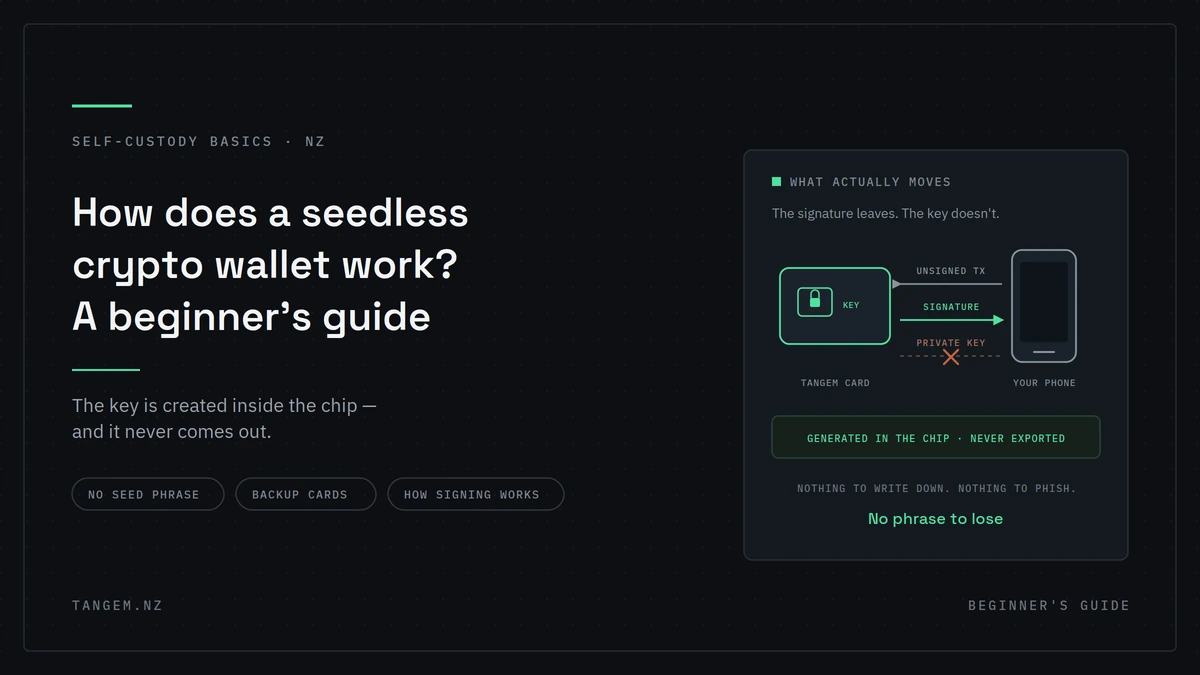
- When you send crypto, you tap the card to your phone. The app passes the unsigned transaction to the card, the chip signs it internally, and the signature comes back. The key itself never leaves.
That last step is the whole design. What travels between the card and your phone is a signature, not a secret.
What “can’t be exported” actually means
The chip is built so the key storage is effectively write-once and non-readable. There’s no command that makes it reveal the key, no menu option, no support process, no manufacturer override.
This is why phishing doesn’t work against it. There is no answer you could give a scammer, even if you wanted to.
Where the app fits in
The app is an interface. Lose your phone, drop it in the harbour, have it stolen: your wallet is unaffected. Install the app on a new phone, tap your card, and everything’s there.
Nothing valuable was ever on the phone in the first place.
If there’s no phrase, what’s the backup?
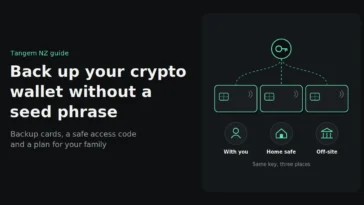
The other devices in your set. A Tangem wallet is sold as a set of two or three cards, or a ring plus two cards. Each device holds the same key and grants identical access.
Redundancy in hardware instead of redundancy on paper.
Why you store them separately
Keeping all three cards in the same drawer defeats the purpose entirely. Different rooms at a minimum; different buildings is better.
The threats you’re protecting against are fire, flood, burglary and simple misplacement, and all four tend to hit one location at a time.
What happens if you lose one
Nothing, in practical terms. Tap any other card in the set and you have full access to the same wallet, with the same balances. You can then follow the process to remove the missing card’s access.
Contrast that with a lost paper phrase. You often don’t know it’s gone until you need it, and by then there’s no alternative route in.
What happens if you lose all of them
Then the wallet is gone. There’s no company backdoor, no recovery service, no support ticket that restores access.
It’s the same position as losing every copy of a seed phrase. It’s also why we’d suggest a three-card set over a two-card one: the price difference is small and it buys you meaningful margin for error.
The security case, stated fairly
Seedless removes the most successful attack in crypto, because it removes the thing attackers ask for. It does not make you immune to everything, and anyone claiming otherwise is selling.
What it genuinely eliminates
- Phishing for your recovery phrase, because there isn’t one
- Photographs of a phrase sitting in cloud backups
- Malware scraping a phrase from a notes app or password manager
- Someone finding your phrase in a drawer, a safe or a book
- Typing your phrase into a convincing fake site
That’s not a small list. It covers the majority of self-custody losses.
What it doesn’t eliminate
- Approving a malicious transaction. Tap your card to sign a drainer transaction and it signs it.
- Sending to the wrong address, including deliberately poisoned lookalikes.
- Scam investments and fake platforms. No hardware evaluates whether something is real.
- Social engineering that convinces you to send funds yourself.
The device secures your key. You still make the decisions, which is why our guide to protecting your crypto from scams is worth ten minutes of your time regardless of which wallet you own.
What the chip certification means
The chip is a Samsung secure element certified to EAL6+, the same security grade used in biometric passports. The firmware has been independently audited by Kudelski Security in 2018 and Riscure in 2023, and it can’t be updated after manufacture, so what was audited is what’s in your hand.
The app is open source and can be rebuilt from public code, and Tangem’s servers aren’t involved in your transactions.
The trade-off: portability
A seed phrase can be restored into any compatible wallet from any manufacturer. A key generated inside a chip can’t leave those cards, so you’re tied to that hardware for that particular wallet.
That’s a real constraint, and it’s worth understanding before you buy rather than after.
What that means in practice
You can’t take a card-generated wallet and restore it into a different brand’s device. If you lose all your cards, no competitor’s hardware can help you. And you can’t move the key itself anywhere, ever.
Why it matters less than it sounds
Because moving crypto and moving keys are different things. If you ever want to switch to another wallet, you send your assets there on-chain. A transaction, not a restore. It costs a network fee and takes minutes.
The only thing that doesn’t transfer is the address itself. For most people that’s irrelevant; if you’ve built something specific around an address, it isn’t.
Seed import is optional
Worth knowing: Tangem can import an existing seed phrase if you want that portability, so seedless is a default rather than a restriction.
We’d generally advise against importing a phrase that’s lived in a browser extension, though. Once a phrase has been on an internet-connected device you can’t prove it’s still private, and putting it onto good hardware doesn’t undo that exposure.
Seedless and seed phrase side by side
| Seedless (chip-generated) | Seed phrase | |
|---|---|---|
| Backup format | Additional cards or ring | 12 or 24 written words |
| What an attacker needs | Physical possession of a card, plus your access code | The words, obtained any way at all |
| Can it be phished? | No, there’s nothing to type | Yes, and this is the most common attack |
| Main loss risk | Losing every device in the set | Losing, damaging or never recording the phrase |
| Restore method | Tap another device in the set | Type the phrase into any compatible wallet |
| Works with other brands | No | Yes |
| Setup time | A few minutes | Longer, plus writing and storing the phrase |
| Best for | Beginners, anyone who’d store a phrase badly | Users needing manufacturer independence |
If you want the fuller comparison of the two models, our seed phrase versus seedless explainer goes deeper on the trade-offs.
Who seedless suits, and who it doesn’t
It suits you if:
- This is your first move into self-custody
- You know you’d store a written phrase badly, or lose it
- You’re worried about being tricked into revealing something
- You’re buying for a partner or family member who isn’t technical
- You want setup measured in minutes, not an afternoon
It’s less suited if:
- You specifically want manufacturer independence for a particular wallet
- You have an address tied to an ENS name, a contract or an allowlist
- You genuinely prefer an air-gapped paper backup you control yourself
Both positions are reasonable. The second group knows why they hold it.
What setup looks like
Tap the first card to your phone to create the wallet. Tap each backup card in turn so they receive the same key. Set an access code. Then, before transferring anything, confirm every card in the set opens the wallet.
That verification step is the one people skip, and it’s the one that matters. An untested backup isn’t a backup.
Our setup guide walks through it properly, and the whole process takes about five minutes.
FAQs
What happens if I lose my Tangem card?
Nothing, provided your other cards are stored safely elsewhere. Tap any other card in the set to access the same wallet, then follow the process to remove the lost card’s access. This is exactly what the multi-card design is for.
Is a seedless wallet safer than a seed phrase?
It removes the most common attack, phishing for your recovery phrase, because there’s nothing to type or photograph. It doesn’t protect you from approving a bad transaction or sending to the wrong address. Safer against the biggest threat; not immune to everything.
Can I recover a seedless wallet without the cards?
No. There’s no backdoor, no company override and no recovery service. That’s the point of the design, and it’s why storing your backup cards in separate locations matters.
Does seedless mean the company holds my keys?
No. The key is generated inside the chip in your hand and never leaves it. Tangem’s servers have no involvement in your transactions, and the app is open source so the code can be inspected.
Can I move my crypto to a different wallet later?
Yes, you send it on-chain to the new wallet, like any other transaction. What you can’t do is export the key itself and restore it into another brand’s device.
Can I still use a seed phrase if I want one?
Yes. Tangem supports importing an existing seed phrase if you need that portability. We’d advise against importing a phrase that’s been used in a browser extension, since its exposure can’t be undone.
What if the company stops trading?
Your existing cards keep working. The key is on the chip and doesn’t depend on any server. The app is open source, so it can be maintained and rebuilt independently. What you’d lose is the ability to buy matching backup cards.
If you’d like to try one, Tangem NZ is an authorised New Zealand seller with 2-card and 3-card sets in stock in Auckland, priced in NZ$ including GST.