Many crypto thefts from hardware wallet owners don’t involve breaking the hardware at all. They start with 24 words: a seed phrase photographed for safekeeping, saved to a notes app, or typed into a convincing fake website.
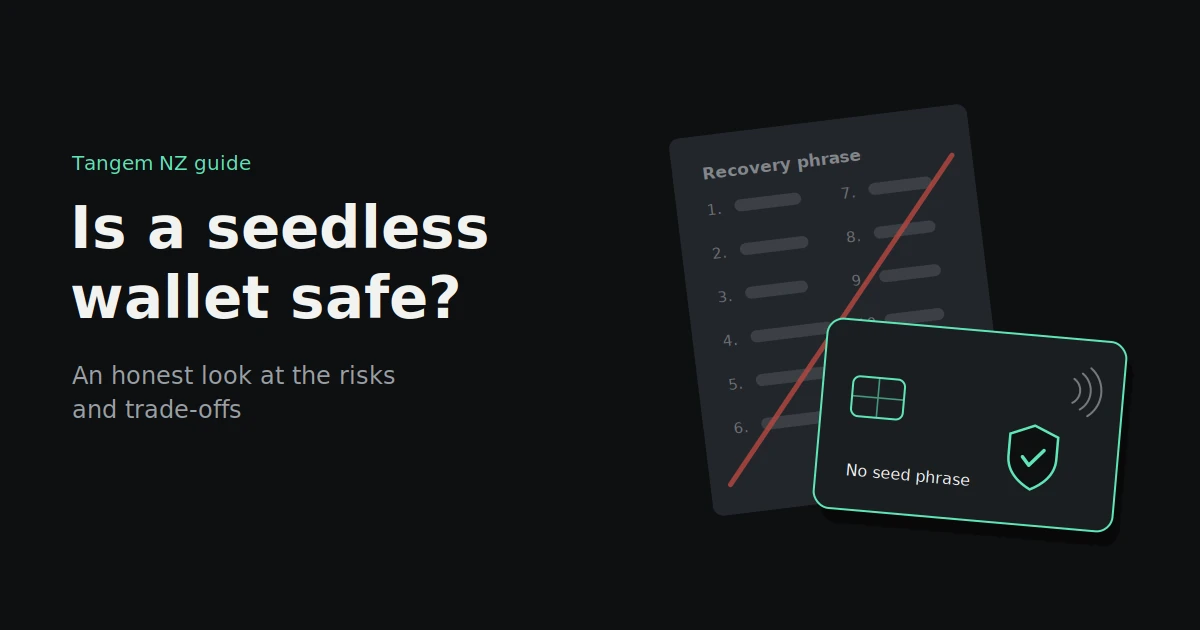
So when a wallet says it doesn’t need a seed phrase at all, it’s fair to be suspicious. Is a seedless wallet safe, or is it removing the one backup that experienced users have always been told to protect?
This guide explains what “seedless” actually means, which risks it removes, which new ones it brings, and how to set one up so it holds up in real life.
The short answer
A well-designed seedless wallet can be as safe as a seed phrase wallet, and safer against the most common thefts, such as phishing and stolen recovery words. How safe it is depends on what replaces the seed phrase. Each design swaps one risk for another, so you need to manage the new one.
With a seed phrase, your biggest risk is someone else finding the words. With a seedless hardware wallet like Tangem, your biggest risk is losing every one of your backup cards. Both risks are manageable. They just call for different habits.
What “seedless” actually means
“Seedless” describes what a wallet doesn’t use, not how it works. There are three main approaches: hardware backup cards, keys split between your phone and a provider’s server, and wallets recovered through a passkey or cloud account. They have very different security profiles, so it matters which one you’re looking at.
Hardware backup cards
This is Tangem’s approach. Your private key is created inside a secure chip on a card or ring and never leaves it. During setup, the key is copied securely to two or three devices. Any one of them can open the wallet, and none of them shows you the key.
There’s no list of words to protect. Instead, you protect physical cards, much like you’d protect a house key.
MPC wallets
MPC (multi-party computation) wallets split the key into shares. Typically, one share sits on your phone and another with the wallet provider. Neither share alone can move funds.
This protects you if your phone is stolen, but it means relying on the provider’s servers and recovery process.
Smart-contract and passkey wallets
Some wallets let you recover access through a passkey, a cloud account or trusted contacts, using smart-contract rules on the blockchain. They’re convenient, but your security becomes tied to the security of that account or those contacts.
This article focuses mainly on hardware backup cards, but the comparison table below covers all three.
Why seed phrases are a weak point
A seed phrase is a complete copy of your wallet written in plain words. Anyone who sees it can take your funds from anywhere in the world, without touching your device. That makes the phrase itself the main target for scammers, rather than the hardware wallet.
Some common ways seed phrases go wrong:
- Phishing. Fake wallet apps, fake support agents and fake “wallet sync” websites ask you to enter your seed phrase. Once you do, the funds are gone.
- Photos and cloud backups. A quick photo of the recovery sheet ends up in your phone’s cloud backup. If that account is ever compromised, so is your wallet.
- Physical discovery. A seed phrase written on paper can be found, photographed and used without you ever knowing until the funds move.
- Inheritance problems. Families may not know what the words are for, or where they are. Or they may find them, but so might someone else.
None of this means seed phrases are bad. Handled well, stored offline and never typed into a website, they’re a proven backup method. They just ask a lot of the person holding them.
How a seedless hardware wallet protects your keys
A seedless hardware wallet like Tangem protects you by never letting the key out. It’s created inside a certified secure chip, used there to sign transactions, and never shown to you or anyone else. With no words to steal, the most common thefts have nothing to target.
What does the work:
- A certified secure chip. Tangem uses a Samsung secure element certified to Common Criteria EAL6+, the same family of security standards used for chips in biometric passports.
- Keys that can’t be exported. The private key is generated inside the chip during activation and never leaves it in readable form. Transactions are signed on the chip itself.
- An access code. You set a code that’s needed to use the card or ring. Without it, someone who finds a lost card can’t simply use it to send funds, barring the lab-grade attack covered below.
- Backup cards. The same key is securely copied to two or three devices during setup, so losing one doesn’t lock you out.
- Independent audits and open-source software. Tangem’s firmware has been audited by Kudelski Security (2018) and Riscure (2023), and its mobile app is open source on GitHub.
- Authenticity checks. The Tangem app verifies that a card or ring is genuine each time you scan it, which helps catch counterfeits.
So there’s nothing for a phishing site to ask for. A fake “wallet support” agent can’t talk you into reading out a seed phrase that doesn’t exist.
The risks a seedless wallet doesn’t remove
Seedless doesn’t mean risk-free. You can still lose every backup, approve a malicious transaction, or rely on a weak access code. With Tangem specifically, there’s also a lab-grade physical attack disclosed in 2026. None of these are reasons to avoid seedless wallets, but you should know about them.
- Losing every backup. If you lose the card or ring and every backup, nobody can restore your wallet: not Tangem, not the seller, not anyone. This is the main risk you take on.
- Approving the wrong transaction. No wallet can stop you signing a malicious transaction or an unlimited token approval on a dodgy website. Tangem has no screen of its own, so you rely on your phone to show what you’re signing. Read it carefully.
- A weak access code. Anyone who has your card and guesses your access code can use it. Choose a code that isn’t your birthday or 123456.
- Counterfeit or pre-used devices. Only buy new, sealed devices from Tangem or an authorised seller, and let the app verify them.
- Provider dependence for MPC wallets. If an MPC provider’s servers or recovery process fail, you may struggle to regain access.
The 2026 laser attack disclosure
In July 2026, Ledger’s security research team, Ledger Donjon, disclosed a laser fault injection attack that can reset the access code on a Tangem card. In practical terms:
- It needs your physical card, a laboratory setup Ledger estimated at about US$250,000, and specialist skills. Each card took around two hours.
- It can’t be patched. Tangem cards don’t support firmware updates, so existing cards remain affected.
- Tangem’s response was that the risk to everyday users is “virtually non-existent”. It also pointed out that Ledger Donjon operates within Ledger, one of its largest competitors.
Our take: for most people, this changes little. Someone would need to steal your card and take it to a specialist lab. It does reinforce two habits, though. Keep your cards physically secure, and if you hold a very large amount, consider spreading it across more than one wallet or setup.
Seed phrase vs seedless wallets compared
Each option trades one risk for another. Seed phrase wallets are flexible but expose you to phishing and stolen words. Backup-card wallets remove the words but depend on physical cards. MPC wallets depend on a provider. Exchanges are easiest but you don’t hold the keys.
| Seed phrase hardware wallet | Seedless backup cards (e.g. Tangem) | MPC wallet | Exchange account | |
|---|---|---|---|---|
| Who holds the keys | You | You | You and a provider, in shares | The exchange |
| Seed phrase to steal | Yes | No (optional) | No | No |
| Phishing for recovery words | Main risk | Not applicable | Not applicable | Account phishing instead |
| Main way to lose access | Losing the phrase | Losing every card | Losing your device and provider recovery failing | Account lock or exchange failure |
| Works with other wallet brands | Yes, through the phrase | Only if you create or import a phrase | Usually no | No |
| Depends on one company | Low | Moderate | High | High |
| Ease of setup | Moderate | Easy | Easy | Easiest |
| Best for | Experienced users who’ll store the phrase carefully | Beginners and anyone wary of phishing | Convenience-focused users | Trading and small balances |
What happens if Tangem disappears?
Your crypto doesn’t live with Tangem. It’s on the blockchain, and your keys are on your cards. Because the Tangem app is open source and published on GitHub, it can be rebuilt even if it were removed from the app stores. But in a seedless setup, you depend more on Tangem’s software than you would with a seed phrase.
Working through the scenarios:
- Tangem has no access to your funds. It doesn’t hold your keys, so it can’t freeze, move or lose your crypto.
- Your cards keep working with the app. Install the Tangem app on any compatible phone and tap a card to access your wallet.
- If the app vanished from the app stores, the open-source code means it, or a compatible app, could be rebuilt. That’s a real safeguard, but a less convenient one than typing a seed phrase into another wallet.
- Seedless keys can’t move to another brand’s device. If you ever wanted to switch to a different wallet, you’d send your funds to it rather than migrate the key.
If vendor dependence worries you, Tangem also lets you create a seed phrase in the app and import it to your cards. That gives you a second, portable recovery route, but it brings back the risk of someone stealing the words. It’s a trade-off, not a free upgrade.
Who a seedless wallet suits, and who it doesn’t
A seedless backup-card wallet suits beginners, people worried about phishing, and families who want simple backups. It’s less suited to experienced users who want maximum portability between wallet brands, or anyone holding very large amounts who’d be better served by a multisig setup.
Good fit:
- First-time self-custody users who’d rather not manage 24 words correctly on day one
- People who’ve been targeted by scams, or who worry they might fall for one
- Families who want backups that are easy to explain: “tap this card to open the wallet”
- Everyday holders who want something simple they can carry or wear
Consider other options if:
- You want full portability between wallet brands through a standard seed phrase
- You hold a very large amount and want protection against any single device or attack, such as a multisig setup across different brands
- You need on-device transaction checks on a hardware screen
Many people combine approaches, for example a Tangem wallet for everyday holdings and a separate setup for long-term savings.
How to set up a seedless wallet safely
Buy genuine hardware, set a strong access code, test every card, and store backups in separate places. In New Zealand, that last step matters more than usual. A fire, flood or earthquake can affect a whole house, so keeping all your cards under one roof defeats the point of having backups.
- Buy new from an authorised seller. Avoid second-hand or opened devices, and never use one that arrives already set up.
- Install the official app. Download the Tangem app from the official App Store or Google Play listing only.
- Set a strong access code. Avoid birthdays, repeated digits and anything someone could guess from your social media.
- Complete the backup to all your cards. Do it during setup, then test each card on its own to make sure it opens the wallet.
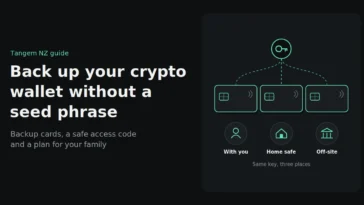
- Store cards in separate locations. For example, one at home, one with a trusted family member in another town, and one in a safe deposit box. In an earthquake-prone country, geographic separation is worth the effort.
- Leave instructions. Write down, for your family, which wallet you use, where the cards are and that they need your access code. Store the instructions separately from the cards, and never with the code.
- Send a small test amount first before moving larger sums.
FAQs
Can a seedless wallet be hacked?
No wallet is impossible to attack. With Tangem, there’s no seed phrase to phish, and keys stay inside a certified chip. The known physical attack, disclosed in 2026, needs your card, a specialist lab and expensive equipment. You can still be tricked into approving a malicious transaction, so check what you sign.
What happens if I lose my Tangem card?
Use one of your backup cards or your ring to open your wallet, as each one holds the same key. Many people then set up a new Tangem set and transfer their funds, so they’re back to a full set of backups. If you lose every card, the funds can’t be recovered.
Is a seedless wallet safer than a seed phrase?
It’s safer against phishing and stolen recovery words, which are common causes of theft. A seed phrase is more portable and doesn’t depend on physical cards. Which is safer for you depends on which risk you’re better at managing.
Can someone steal my crypto if they find my Tangem card?
Not without your access code, in normal circumstances. The 2026 laser attack showed that a lab with specialist equipment could reset the code, so keep your cards physically secure and use a strong, hard-to-guess code.
Can I add a seed phrase to Tangem later?
Generally, you choose between seedless and seed phrase when you set up a wallet. Switching usually means setting up a new wallet with a seed phrase and transferring your funds. Check Tangem’s current guidance before you do.
Is Tangem safe to use in New Zealand?
Yes. Tangem works the same in New Zealand as anywhere else, and holding crypto in your own wallet is legal here. Buy from an authorised seller so you get genuine, unused devices and local support.
Seedless wallets aren’t magic, and they aren’t a gimmick either. They swap the risk of stolen words for the job of looking after physical backups. For many New Zealanders, that’s an easier job to get right.
If you’re ready to try seedless self-custody, buy genuine Tangem wallets from Tangem NZ, with NZD pricing including GST and a New Zealand team to help with setup. If you’re not sure it suits you, get in touch and we’ll give you a straight answer.