You own crypto in a Tangem wallet. You’ve held some coins for months, others for years. You’ve made a few trades along the way. And you don’t actually know what the IRD expects at tax time, because most of what you’ve read online is either American (where the rules are completely different) or so generic it doesn’t tell you which actions on a self-custody wallet trigger which obligations.
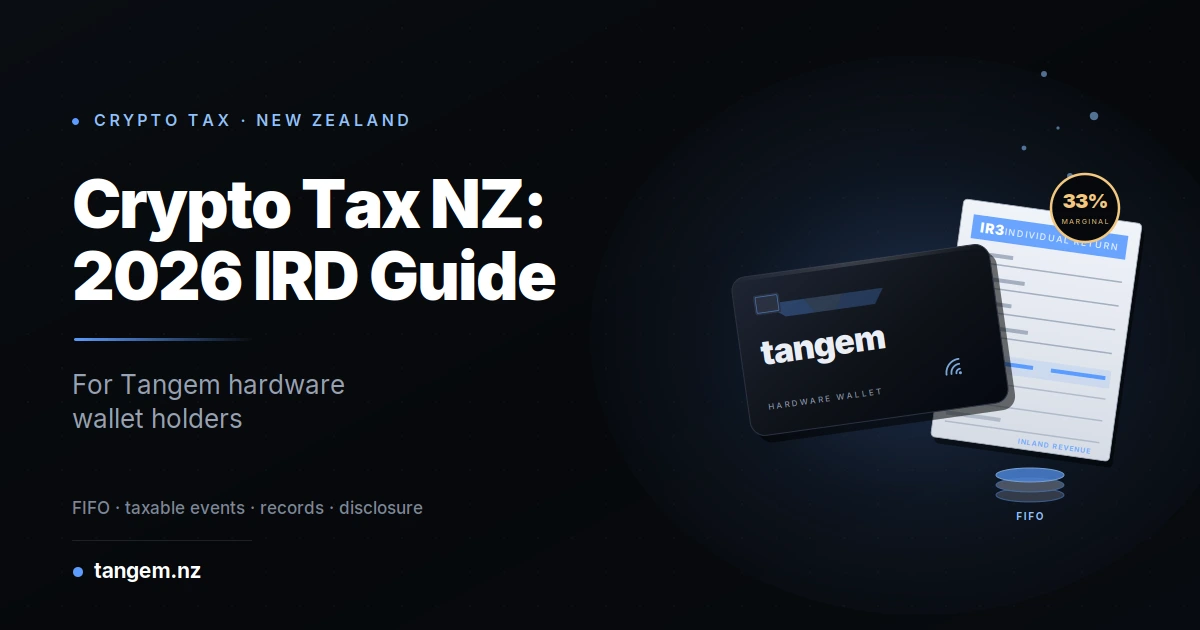
This is the practical Crypto Tax in New Zealand 2026 IRD guide for Tangem users: what counts as a taxable event, how the IRD treats hardware wallet holders specifically, what records you need to keep, and what to do if you haven’t declared before.
Important: this article reflects IRD guidance as of early 2026. Crypto tax rules have changed several times since 2020 and will keep changing. Nothing here is tax advice for your specific situation. Verify current guidance at ird.govt.nz and consult a chartered accountant with crypto experience before filing.
The short answer on crypto tax in NZ for 2026
The IRD treats cryptocurrency as property, not currency. Any gain from disposing of crypto (selling to NZD, trading for another crypto, spending it on goods) is treated as income and taxed at your marginal rate, 10.5% to 39%. There is no capital gains tax exemption and no universal small-holdings threshold.
The “acquired for the dominant purpose of disposal” rule
The IRD’s core position: if you acquired cryptoassets intending to eventually sell them, any profit is taxable income. In practice this catches nearly every crypto holder, because almost nobody buys crypto planning to hold it forever without ever converting it back to fiat or spending it. This is why “I’m just holding” isn’t a defence.
What counts as a taxable event with your Tangem wallet
Six actions on a Tangem wallet trigger taxable events under IRD rules: selling to NZD, swapping one crypto for another, spending crypto on goods or services, receiving staking rewards, receiving airdrops or hard-fork tokens, and receiving crypto for services rendered. Simply holding, or transferring between your own wallets, doesn’t trigger anything.
Selling to NZD
The clearest taxable event. You sell 0.5 BTC on an exchange for NZD and transfer the NZD to your bank. The difference between your cost base (what you paid) and the NZD value at sale is your taxable gain or loss.
Crypto-to-crypto swaps
This is the one that catches most people. Trading BTC for ETH is treated as two events: you disposed of BTC (taxable) and acquired ETH (a new cost base for future disposals). Both are measured in NZD equivalent at the swap date. You don’t need to convert to NZD for the tax event to happen; the trade itself is the trigger.
Using crypto to buy things
Spending 0.1 BTC on a purchase is a disposal of that BTC at its NZD-equivalent value on the day. Your gain or loss is calculated against your original cost base.
Staking rewards, mining income and DeFi yield
Rewards received in crypto are income at their NZD market value on the date received. If you receive 0.5 ETH as a staking reward when ETH is worth NZ$4,000, that is NZ$2,000 of taxable income for that year, even if you never sell the ETH.
Airdrops and hard-fork tokens
Free tokens received via airdrops or hard forks are typically taxable income at their NZD value on receipt, if there was a reasonable market for them at that time.
What isn’t taxable
Holding crypto, no matter how long, is not a taxable event. Transferring between your own wallets (an exchange to Tangem, Tangem to MetaMask, and so on) doesn’t trigger tax. Buying crypto with NZD doesn’t trigger tax either; it establishes your cost base for the next disposal.
The IRD’s stance on hardware wallets and self-custody
Using a hardware wallet like Tangem doesn’t change your tax obligations. The IRD doesn’t care where your crypto lives; it cares about transactions. But self-custody creates a practical challenge: there is no exchange handing you summary reports, so you are responsible for your own complete transaction records.
Why Tangem users need better records than exchange-only users
If you only ever traded on Binance NZ or Independent Reserve, those exchanges keep transaction records you can download for your accountant. Once you moved crypto to a Tangem wallet and started swapping there, through a DEX, a bridge or the wallet’s built-in swap, you left the exchange’s record-keeping. Every one of those swaps is still taxable; you just don’t have a neat CSV to point at.
The fix is to build the records as you go. Every swap, stake reward and DeFi interaction on your Tangem wallet needs to be logged manually, or tracked with a portfolio tool that reads your public addresses.
What the IRD can actually see
More than you might think. The IRD has memoranda of understanding with major NZ exchanges (Binance NZ, Easy Crypto, Independent Reserve and others) requiring them to share customer transaction data. It also has access to blockchain analysis tools that can trace transactions from exchange wallets to your Tangem addresses. If you bought crypto through an NZ exchange, the IRD likely knows you own crypto. The question is whether you’ve reported the disposals correctly.
How to calculate your crypto gains (FIFO)
New Zealand uses First-In-First-Out (FIFO) as the standard cost base method. You calculate gains by matching your earliest acquired crypto against your first disposal. This matters because if you bought crypto cheaply years ago and sell now, the “first out” is the cheapest coin, which usually means the biggest taxable gain.
Worked example: a typical Tangem holder
- 2022: buy 1 BTC at NZ$45,000 (transferred to Tangem)
- 2024: buy 0.5 BTC at NZ$65,000 (also on Tangem)
- 2026: sell 1 BTC at NZ$120,000
Under FIFO, the 1 BTC sold is matched to the 2022 purchase (first in). Your taxable gain is $120,000 minus $45,000 = $75,000. That $75,000 is added to your taxable income for the 2026 year and taxed at your marginal rate.
If you are already in the 33% bracket, the tax owed is roughly $24,750. If the gain pushes you into the 39% bracket, the portion above the threshold is taxed at the higher rate.
Staking rewards and DeFi income
For each reward received, record the date, the crypto amount and the NZD market value at that moment. That NZD value is your taxable income for the year. When you later sell or swap the reward token, the cost base for calculating the gain is that same NZD value.
NZ income tax brackets (2026)
Your crypto gains stack on top of your salary. If your salary already puts you at 33%, your crypto gains are taxed at 33% from the first dollar. If gains push you into a higher bracket, only the portion above the threshold gets the higher rate.
| Annual income (NZD) | Marginal tax rate |
|---|---|
| $0 to $15,600 | 10.5% |
| $15,601 to $53,500 | 17.5% |
| $53,501 to $78,100 | 30.0% |
| $78,101 to $180,000 | 33.0% |
| Above $180,000 | 39.0% |
Verify current brackets at ird.govt.nz. Thresholds and rates have been adjusted several times in recent years.
Trader or investor: which one are you?
The IRD distinguishes casual holders (investors) from active traders. Most Tangem users are investors: they hold for months or years, treat crypto as a store of value, and trade infrequently. Traders face different rules. Their crypto is trading stock, losses are deductible against income, and reporting requirements are more detailed.
How the IRD decides
There is no hard threshold. The IRD looks at frequency of transactions (a handful per year versus dozens per month), how long you hold (years versus days), volume relative to your income (a side interest versus your main income), and the sophistication of your approach (casual research versus professional tools and strategies).
What changes if you are classified as a trader
- Your crypto is treated as trading stock with year-end valuation adjustments
- Losses become deductible against other income
- More detailed record-keeping is required
- Potentially more scrutiny at audit
The practical test for most Tangem users
If you bought crypto over months or years, moved it to a Tangem wallet for long-term self-custody, and trade infrequently, you are an investor. If you are day-trading, running arbitrage strategies, or generating your main income from crypto activity, you are a trader and you need specialist advice.
The personal-use exception, a common misconception
Many NZ holders believe small crypto purchases (under $10K, or “for personal use”) are tax-exempt. This exception has very narrow application in IRD guidance and doesn’t apply to most crypto holdings. It only applies when the crypto was specifically acquired to spend on personal goods or services, not held as an investment or with any speculative intent. Don’t rely on it without professional advice. Misapplying this exception is one of the more common ways NZ crypto holders create audit exposure.
Record-keeping for Tangem users
The IRD requires you to keep records of every taxable event for seven years after your return is filed. Missing records shift the burden of proof onto you. If you can’t document your cost base, the IRD can assume it is zero and tax the entire disposal value as gain.
What to record for each transaction
- Date, in NZ time
- Type: buy, sell, swap, receive, spend, stake reward, airdrop
- Exact crypto amount
- NZD value at transaction time, from a reputable price source
- Cost base for disposals (what you originally paid, in NZD)
- Counterparty if relevant: exchange, DEX, protocol name
- Wallet addresses involved, for Tangem-based transactions
Tools that work for NZ users
Portfolio trackers that support NZ tax methodology (Koinly, CoinTracker, CryptoTaxCalculator) can auto-generate FIFO reports if you connect your Tangem public addresses. They cost roughly $60 to $150 a year, save 20-plus hours of manual tracking, and produce reports your accountant can work from directly. Worth it if you have more than a handful of transactions a year.
Filing your return
Crypto income is declared in your annual IR3 tax return (or IR3NR if you are non-resident). If you are otherwise PAYE-only, the IRD may not automatically flag your crypto income, but you are still legally obliged to declare it. Omitting significant crypto income can be treated as tax evasion rather than oversight if it is material.
The steps
- Compile transaction records for the tax year (1 April to 31 March)
- Calculate gains and losses using FIFO, or a tax tool
- Add total net gains to your IR3 under “Other income”
- Include staking, airdrop and DeFi income at NZD value at receipt
- Keep supporting records for seven years
If you haven’t declared previously
The IRD’s voluntary disclosure programme significantly reduces penalties if you come forward before an audit. Full unprompted disclosure can reduce shortfall penalties from up to 150% down to as low as 20%. Given the IRD’s expanding crypto surveillance since 2023 (data-sharing with exchanges, blockchain analysis), waiting to see if you are caught is worse than coming forward.
IRD crypto enforcement, 2024 to 2026
The IRD has said publicly that crypto is a compliance focus. Data-sharing agreements with major NZ exchanges mean it receives regular reports of NZD-to-crypto purchases and disposals. If you bought through an exchange and disposed off-exchange, via your Tangem wallet, the mismatch is detectable. Voluntary disclosure through a chartered accountant is the standard path to resolving unreported historical gains without the 150% penalty exposure.
FAQs
Do I have to pay tax on crypto I’ve never sold?
Generally, no. Holding isn’t a taxable event. You owe tax when you dispose of it: sell, swap or spend. Staking rewards, airdrops and mining income are the exception; they are taxable at receipt, even if you haven’t sold the reward tokens.
Is crypto tax-free in NZ under a certain amount?
No. There is no universal small-holdings exemption. The personal-use exception exists but has very narrow application and doesn’t apply to most crypto holdings. Don’t assume small crypto activity is exempt.
What if I lost money on crypto? Can I claim it?
As an investor, losses on crypto are generally not deductible against other income, though you can typically use them to offset other crypto gains in the same year. The rules depend on your situation. As a trader, losses are deductible against other income. Speak to an accountant about your classification.
Do I owe tax if I moved crypto from an exchange to my Tangem wallet?
No. Transferring crypto between your own wallets, including from an exchange to a Tangem hardware wallet, isn’t a disposal and isn’t taxable. The cost base carries over.
How does the IRD know I own crypto?
Data-sharing agreements with major NZ exchanges (Binance NZ, Easy Crypto, Independent Reserve and others), plus blockchain analysis tools. If you bought crypto through an NZ exchange, assume the IRD knows.
What tax rate applies to my crypto gains?
Your marginal income tax rate: 10.5%, 17.5%, 30%, 33% or 39%, depending on your total taxable income. Crypto gains stack on top of your salary.
Do I need an accountant, or can I file crypto tax myself?
For simple situations (a few disposals a year, all through NZ exchanges), you can file yourself using a crypto tax tool plus your IR3. For anything involving DeFi, cross-chain activity, significant Tangem-wallet trading, or historical undeclared gains, use a chartered accountant with crypto experience. The cost, typically $400 to $1,500 a year, is small compared with the penalty exposure for errors.
Keeping your holdings in one place makes the record-keeping easier. If you are still spread across exchanges, Tangem NZ is an authorised New Zealand seller with wallets in stock in Auckland, priced in NZ$ including GST.