Your Tangem wallet holds crypto that matters to your family’s future. Your cards (or seed phrase) sit somewhere safe. You’ve never told your spouse or kids exactly where they are or how to use them. And you’ve quietly realised that if something happens to you tomorrow, your crypto might as well not exist, because they can’t get at any of it.
Crypto estate planning in NZ
This is the practical framework for solving that. Crypto estate planning in NZ, and how to pass down Bitcoin legally, is not only about writing “my Bitcoin goes to my daughter” in your will. It needs three things working together: a legally valid will, a recoverable custody plan for your cards or seed phrase, and a named person who both understands what to do and has the technical ability to do it.
The short answer
Passing down Bitcoin (or any crypto) in New Zealand requires three things: (1) a legally valid will that specifically references your crypto assets, (2) a secure but recoverable custody plan for your seed phrase or hardware wallet cards, and (3) a designated executor or family member who knows what to do and can technically carry out the transfer.
Miss any of the three and your crypto is effectively lost after your death. The balance still exists on the blockchain, but no one can access it.
Why crypto is different from traditional inheritance
Traditional inheritance works because assets are held by institutions: banks, share registries, the land titles office, insurance companies. Those institutions keep records independent of the deceased. When someone dies, the executor contacts the institution, provides probate documents, and the assets are transferred.
Self-custody crypto has no such institution. If your seed phrase or Tangem cards can’t be recovered after your death, no bank, exchange, probate court or government agency can recover the assets. The wealth exists on the blockchain but is functionally destroyed. Estimates suggest around 20% of all Bitcoin ever mined is permanently lost, a good part of it to deaths without any inheritance planning.
The self-custody trade-off
Self-custody gives you complete control while you’re alive: no exchange freezes, no bank refusals, no intermediary. It also means you carry complete responsibility for what happens after. There is no support desk to call, no forgotten-password recovery, no “prove your identity and we’ll help you” fallback.
What the IRD sees versus what your executor can access
The IRD may know you own crypto, through exchange data-sharing. Your bank records may show fiat purchases of crypto. Your executor can see these records, but visibility doesn’t grant technical access. Knowing you have crypto and being able to move it are two entirely different problems.
NZ succession law and your crypto
New Zealand succession law treats crypto as property in your estate. Your will controls its distribution to beneficiaries. Without a will, the Administration Act 1969 distributes assets under intestacy rules, typically to your spouse and children in defined proportions. Your crypto is legally covered by NZ law; the challenge is practical access.
The role of your executor
Your executor has legal authority, granted by the will and probate, to distribute your assets. Legal authority doesn’t confer technical capability. An executor who can’t recover a seed phrase or operate a hardware wallet is stuck, regardless of what powers your will grants them. This is the single biggest structural weakness in most NZ crypto estates.
The Family Protection Act 1955
Your spouse, children and certain other family members can claim provision from your estate under the Family Protection Act 1955 if they believe your will inadequately provides for them. This applies to crypto like any other property. If you plan to leave your crypto entirely to one person while excluding others, discuss it with your estate lawyer, because the Act may override your intentions.
Testamentary trusts for crypto
For substantial holdings, a testamentary trust created by your will can hold crypto for minors, family members with special circumstances, or beneficiaries you want to receive assets gradually rather than as a lump sum. Setting up a testamentary trust that actually works for crypto, with clear technical instructions for the trustee, needs specialist legal advice.
The custody problem is the hard part
Your will can legally direct crypto to beneficiaries, but only if the seed phrase or hardware wallet can actually be recovered. That creates a paradox: the seed phrase or cards must be secure enough that no one steals them during your lifetime, yet findable enough that someone recovers them after your death.
Four common solutions, each with real trade-offs:
Solution 1: full disclosure to spouse or executor
Tell your spouse or trusted executor where the seed phrase or cards are and how to use them. Simplest solution, and it works reliably. Risks: family dynamics change (divorce, disputes), one person has complete control while you’re alive, and there is a coercion risk if someone learns they hold the keys.
Solution 2: physical vault with instructions in your will
Store the seed phrase or a card in a bank safe deposit box or home safe, and reference its location and access procedure in your will. It is only accessible after probate is granted. Risks: probate takes three to six months or more, which is a long time to leave crypto inaccessible; the executor still needs technical knowledge; bank access requires documentation.
Solution 3: Shamir Secret Sharing or multisig
Split your seed phrase across multiple trusted parties (say, three of five shares needed to recover), or use a multisig wallet that requires several signatures. Best for large holdings. Risks: technical complexity, all custodians need to remain alive and cooperative, and the recovery process must be clearly documented.
Solution 4: professional crypto estate service
Third-party services hold your seed phrase or cards under release conditions triggered by a death certificate. A growing category. Risks: you are trusting the provider, there are ongoing fees, the provider has to outlive you, and jurisdiction matters.
The four solutions compared
| Solution | Security during life | Ease of recovery | Cost | Best for |
|---|---|---|---|---|
| Full disclosure to spouse | Medium | High | Free | Strong family trust, moderate holdings |
| Physical vault + will | High | Medium (delay) | Low | Solo owners, medium holdings |
| Shamir/multisig | Very high | Complex | Low to medium | Large holdings, technical family |
| Professional estate service | High | High | Ongoing fee | Large holdings, non-technical family |
How Tangem changes the inheritance picture
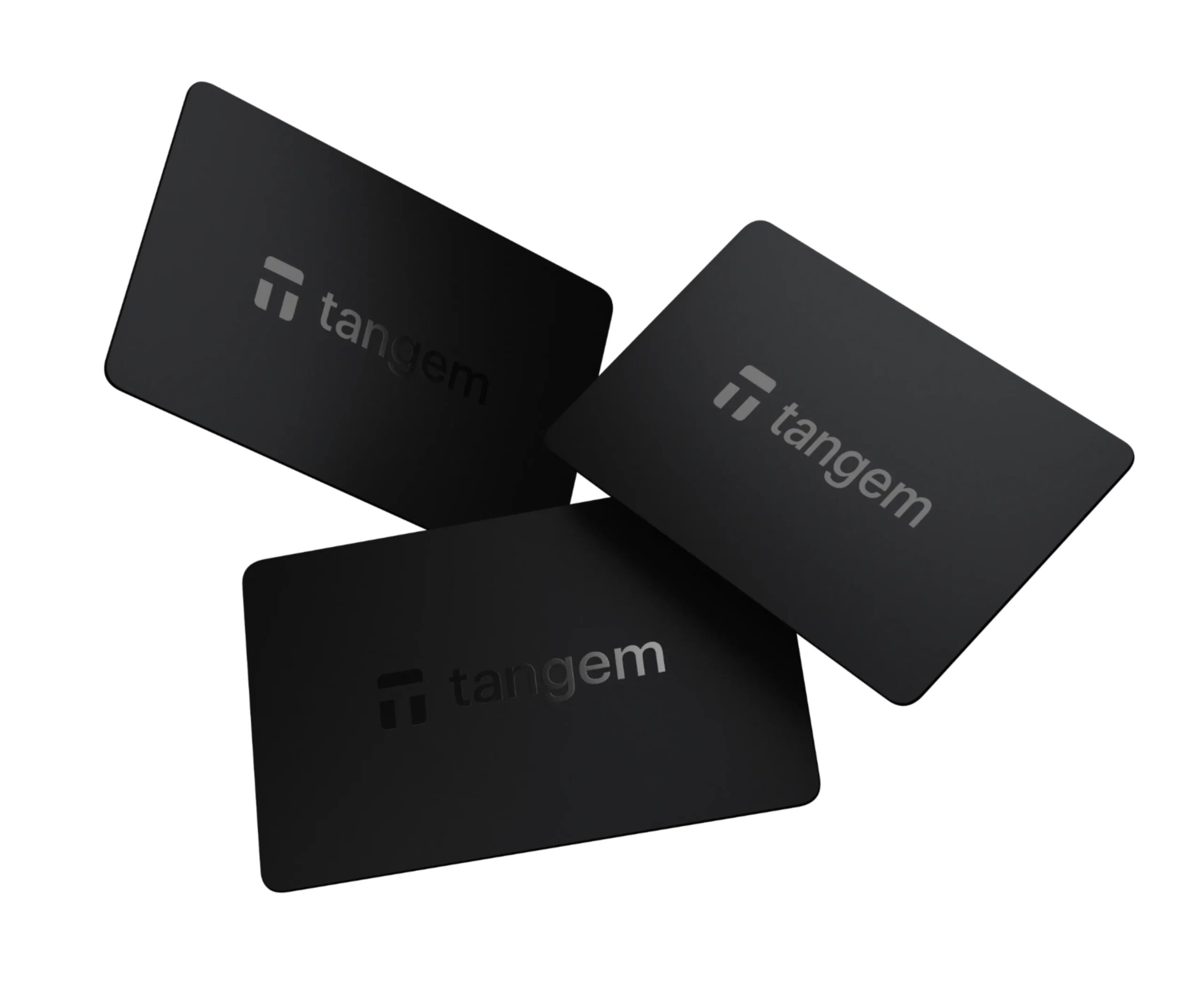
Tangem’s card-based wallets handle inheritance differently from seed-phrase wallets. Because the private key lives on the physical card (with backup cards created at setup), inheritance becomes mostly a physical hand-over problem. Pass a card and the access code to the beneficiary and they have full control.
For many families this is genuinely simpler than seed-phrase inheritance.
Backup cards as the inheritance strategy
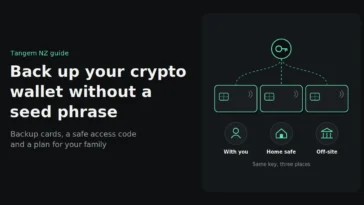
Tangem wallets come as 2-card or 3-card sets. The usual arrangement:
- Card 1: your daily-use card, kept with you
- Card 2: sealed and stored in a location known only to you (home safe, bank safe deposit box)
- Card 3: sealed and stored with your executor, or referenced in your will’s location instructions
After your death, your beneficiary receives Card 2 or 3, whichever you designated. They learn the access code through your will’s instructions, tap the card on their own phone, and full access transfers cleanly. There is no seed phrase to lose or steal.
Passing on the access code without exposing it during life
Your Tangem access code protects the card during your lifetime, and your beneficiary needs it to use the inherited card. Options:
- Put the code in a sealed envelope stored with your will, to be opened only by your executor
- Use a professional will-storage service (Public Trust, or your family lawyer) that holds sealed documents until needed
- Document the retrieval procedure clearly in your will’s schedule of assets
Never write the code on the card or keep it in the same place. The code is worthless without the card, and the card is worthless without the code.
Compared with seed-phrase inheritance
Cards remove two of the big seed-phrase failure modes: transcription errors (a beneficiary miscopying a 24-word phrase and losing everything) and partial recovery (finding some words but not others). With Tangem, either the card works or it doesn’t. There is no partial-recovery scenario.
The practical checklist
A working NZ crypto estate plan has eight documented items. Skip any one and your beneficiaries may face an unsolvable access problem:
- A written will that specifically references your crypto assets by category (Bitcoin, Ethereum and so on), not just “digital assets”
- A named executor with, or connected to, technical capability
- An inventory of all crypto assets: which wallets, which exchanges, approximate balances
- A seed phrase or card custody plan with a documented recovery procedure
- Access code and credential documentation, stored separately from the cards
- Beneficiary designations with clear division instructions (percentages or fixed amounts)
- Step-by-step technical transfer instructions written for a non-technical executor
- A regular review, annually or after any major life event (marriage, divorce, new children, new wallets)
Missing item 7 is the most common failure. Executors often have legal authority but no idea how to move crypto. Instructions a competent non-crypto person can follow are what make the plan work.
Who actually moves the crypto
Your executor has the legal authority to distribute your crypto, but usually lacks the technical ability to carry out the transfers. Most successful NZ crypto estates use one of three arrangements.
Option 1: a technically capable family member as co-executor
Name a technically comfortable family member (adult child, sibling) as co-executor alongside your traditional executor (lawyer, family friend). The technical co-executor handles crypto; the traditional executor handles fiat assets, real estate and probate paperwork.
Option 2: a professional crypto estate service
A growing category of specialist services, typically based overseas, that assist with crypto transfer under estate authority. Costs range from setup fees to a percentage of assets transferred.
Option 3: detailed written instructions
Write step-by-step technical instructions detailed enough that a non-crypto executor can follow them exactly. Include screenshots, specific button presses and the expected result at each step. Test the instructions with a small amount of crypto before finalising. Done thoroughly, this works surprisingly well.
Tax on inherited crypto in NZ
New Zealand has no inheritance tax, unlike the UK or some US states, so inherited crypto isn’t taxable to the beneficiary at the moment of inheritance. When the beneficiary later disposes of it, standard NZ crypto tax rules apply, based on the market value at the date of inheritance.
The cost base at inheritance
The beneficiary’s cost base is the NZD market value on the date of your death. If your Bitcoin was worth NZ$100,000 at your death and is later sold for NZ$150,000, the beneficiary’s taxable gain is NZ$50,000, not the full NZ$150,000 they received. This is considerably more favourable than inheriting shares in some other jurisdictions.
What the beneficiary owes when they eventually sell
Your beneficiary faces the same NZ crypto tax rules as any holder. Our Crypto Tax in New Zealand guide for Tangem users sets out the full framework. The key point: the tax event happens when they sell, not when they inherit.
Common mistakes NZ Tangem users make
Four patterns cause most crypto inheritance failures in New Zealand:
- No documentation of assets. The family doesn’t know you own crypto, let alone how much or where.
- Seed phrase or cards inaccessible, secured so thoroughly that legitimate recovery becomes impossible.
- An executor without technical capability and without clear instructions. Legal authority alone doesn’t move crypto.
- No update after major life events: divorce, remarriage, new children, crypto moved to new wallets.
Any one of these can destroy the inheritance. All four together make the estate plan theatre.
FAQs
Do I need to include my Bitcoin in my will?
Yes. Without a specific reference in your will, your crypto still passes legally under intestacy rules, but with much more difficulty. A will that specifically references crypto assets, by wallet type and approximate holdings, makes the executor’s authority clearer and reduces disputes.
What happens to my crypto if I die without a will in NZ?
Distribution follows the intestacy rules in the Administration Act 1969, typically to your spouse and children in defined proportions. Without documented seed phrase or card recovery information, the crypto may be legally allocated but practically inaccessible. Intestacy is genuinely worse for crypto than for traditional assets.
Can I put crypto in a family trust in NZ?
Yes, with specialist legal advice. Living trusts and testamentary trusts can both hold crypto, but the trustees need clear instructions and technical capability. Trust structures suit large holdings that benefit from long-term, controlled distribution.
Is my seed phrase private information or an estate asset?
Both. During your life it is private information you control. After your death, what it unlocks becomes an estate asset, but the phrase itself remains sensitive. Store and transfer it with security appropriate to what it accesses.
What if my beneficiary is a minor?
You typically need a testamentary trust or an appointed guardian to hold the crypto until they reach the age you specify (usually 18 or older in NZ). Direct transfer to a minor isn’t legally clean and can create tax complications. Discuss it with your estate lawyer if any of your beneficiaries are children.
Does NZ have inheritance tax on crypto?
No. New Zealand has no inheritance tax, so your beneficiaries owe nothing at the moment of inheritance. They will be taxed on any gain when they later dispose of it, calculated from the market value at the date of inheritance.
Should I tell my spouse my seed phrase now?
It depends on your situation and your relationship. Full disclosure to a trusted spouse is the simplest solution, but consider whether family circumstances make it appropriate. Sealed instructions accessible only after death is a middle path that preserves lifetime privacy while ensuring recovery afterwards.
If your plan needs a third card to leave with an executor, Tangem NZ is an authorised New Zealand seller with 3-card sets and the Family Pack in stock in Auckland, priced in NZ$ including GST.