Shop for crypto wallets in NZ for more than a few minutes and you’ll run into two different ideas about how to keep your keys safe. One gives you a list of 12 or 24 words to guard. The other gives you no words at all. The choice sounds technical. It is actually the main thing that decides whether you can still get at your crypto in ten years.
This post explains both models, where each one fails, and which kind of person each suits.
Seed phrase wallets
A seed phrase wallet generates a recovery phrase when you first set it up, usually 12 or 24 words drawn from a fixed list under the BIP-39 standard. The phrase encodes your private key. Anyone who has the words, in order, can rebuild the wallet on any compatible device and move the funds. Ledger, Trezor, MetaMask and Trust Wallet all work this way.
Restoring is simple in principle. You type the words into a new device and your balances reappear. The weak point isn’t the cryptography, it’s the person holding the paper.
Where seed phrases go wrong
The model puts the entire security job on you. You have to write the phrase down correctly, keep it somewhere that survives fire and water, never photograph it or type it into anything connected to the internet, and never lose it. One wrong word, or one lost notebook, and the wallet is gone for good.
This happens a lot. Chainalysis has estimated that up to around a fifth of all bitcoin is sitting in wallets nobody can open any more, and lost or mishandled recovery phrases are a large part of that. The other failure is theft: almost every “support” scam in crypto ends with the victim typing their seed phrase into a fake website.
Seedless wallets
A seedless wallet never produces a recovery phrase. The private key is generated inside a hardware chip and stays there. Backup is done by hardware too, rather than by a human copying words onto paper.
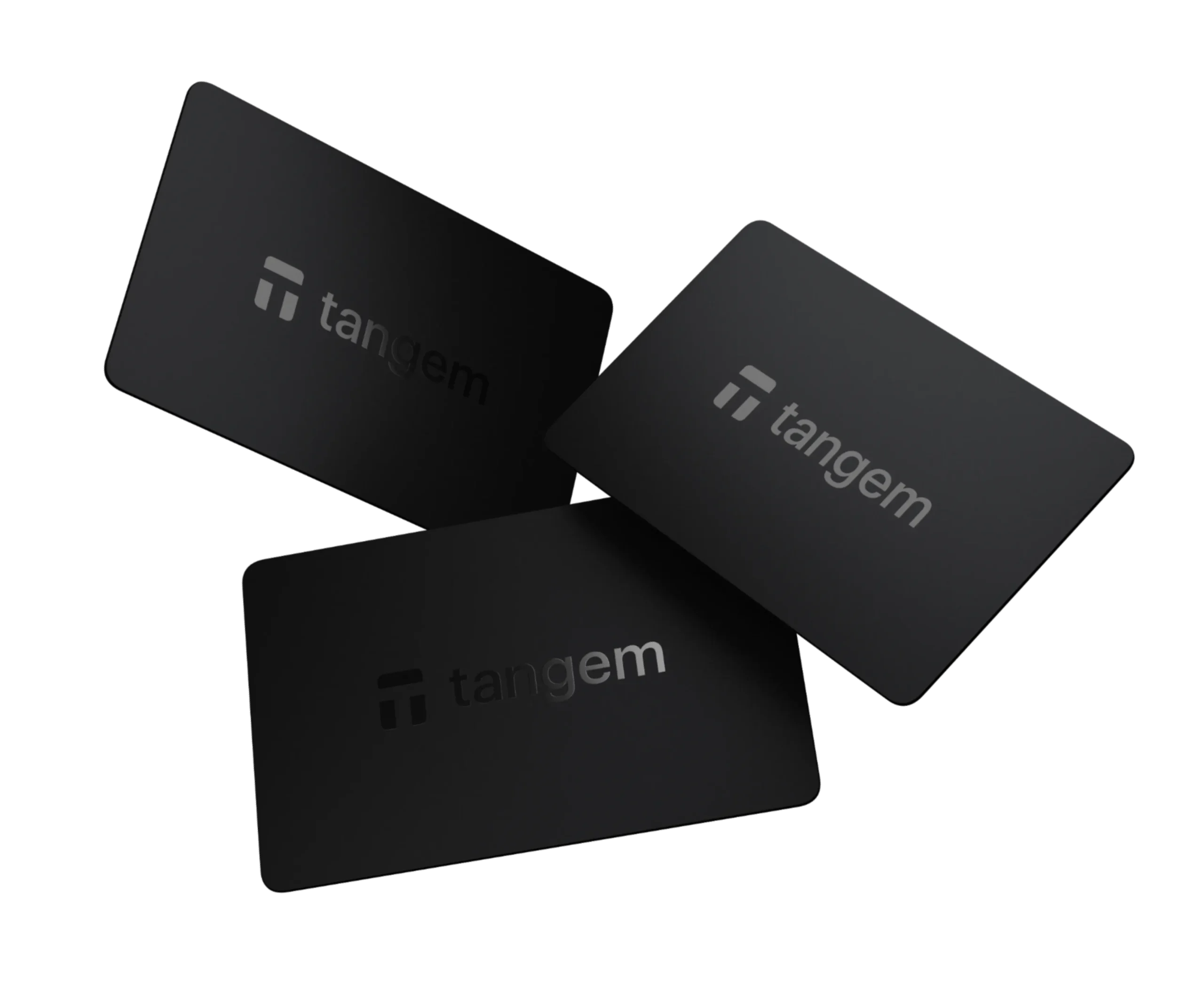
Tangem is the best-known example. A Tangem set is two or three cards (or a ring plus two cards). During setup the key is created on the first device and copied securely to the others, so every device in the set opens the same wallet. Lose one, use another. There’s nothing written down anywhere to find, photograph or phish.
You can still add a seed phrase to a Tangem wallet if you want one. It’s optional rather than compulsory, which is the point.
Side by side
| Feature | Seed phrase wallet | Seedless wallet (Tangem) |
|---|---|---|
| Recovery method | 12 to 24 word phrase | Backup cards or ring |
| Main risk | Phrase lost, copied or phished | All devices lost at once |
| Setup | 15 to 30 minutes, careful writing | A few minutes, tap each card |
| What you store | Paper or metal plate, hidden | Cards, kept apart |
| Moving to another brand | Easy, import the phrase | Only if you created the optional phrase |
| Suits | Experienced users with a storage plan | Most people, especially newer holders |
Why more New Zealanders are going seedless
Most people who contact us are moving crypto off an exchange for the first time. They’re not worried about advanced features; they’re worried about doing something irreversible by accident. For that person, a seed phrase is a liability. It ends up in a photo, a notes app or an email draft, because that’s where people put important things.
Seedless storage removes that entire category of mistake. There is no phrase to store badly, mistype or hand to a scammer. The remaining job is to keep two or three cards in different places, which is the sort of thing people already do with passports and spare keys.
What Tangem does with the idea
Tangem is a Swiss company and its cards have been on the market since 2017. The chip is a secure element certified to EAL6+, the class used in passports and bank cards. The firmware was audited by Kudelski Security and Riscure and is fixed at manufacture, so there are no updates to install and nothing for an attacker to overwrite later. The cards are IP69K rated and carry a 25-year warranty.
The app handles more than 90 networks and over 16,000 tokens, including swaps, staking and WalletConnect, so going seedless doesn’t mean giving up DeFi.
How the card backup works
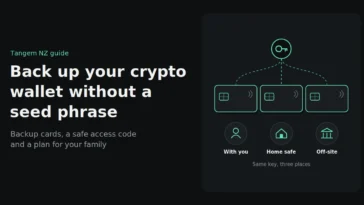
At setup you tap the first card to create the key, then tap the second and third to copy it. The copy happens chip to chip through the app, encrypted, and the key is never visible to the phone. From then on each card is interchangeable. If you lose one you still have two; if you lose two you still have one, and you’d then set up a fresh set and move the funds.
The difference comes down to this: with a seed phrase, losing the phrase means losing everything. With a card set, losing a card means reaching for the next one.
When a seed phrase wallet is still the right call
Seed phrases aren’t wrong, they’re demanding. They make sense if you already have a proper storage setup (a metal plate in a safe, say), if you want to be able to restore the same wallet into several different brands of software, or if you run a multisig arrangement that needs standard keys. If that’s you, you know it, and the discipline is already part of your routine.
For most New Zealand holders, particularly anyone new to self-custody, the risk of a seed phrase is bigger than it looks and the benefit is smaller than it sounds.
Which should you pick
If you want strong security without having to be careful every day, a seedless set is the easier thing to live with. If you’re an experienced user with specific compatibility needs and a storage plan you trust, a seed phrase device is still a fine choice.
You can see the current Tangem range and NZ pricing at tangem.nz. For the technical detail on the chip certification and security architecture, the official Tangem site publishes the documentation.
Frequently asked questions
What is a seed phrase and why is it risky?
A seed phrase is a sequence of 12 to 24 words that acts as a master key to your crypto wallet. It's risky because if you lose it, forget it, or it's stolen, you permanently lose access to all funds in that wallet. There is no customer support line that can recover it for you.
What is a seedless crypto wallet?
A seedless crypto wallet is a hardware wallet that secures your private key on a physical device — such as a chip inside a card — without generating a seed phrase. Instead, backup is managed through additional physical devices, removing the risk of seed phrase loss or theft.
Is Tangem available in New Zealand?
Yes. Tangem is fully available in New Zealand through tangem.nz. It ships directly to New Zealand addresses and supports NZD-friendly purchasing options.
Is a seedless wallet safer than a seed phrase wallet?
For most everyday users, yes. Seedless wallets eliminate the human error risk associated with recording, storing, and protecting a seed phrase. Tangem's chip-level security (EAL6+) also means private keys are never exposed, even during use.
Can I store multiple cryptocurrencies on a Tangem wallet?
Yes. Tangem supports thousands of cryptocurrencies and tokens across multiple blockchains, including Bitcoin, Ethereum, Solana, Polygon, and many more — making it a genuinely versatile option for New Zealand investors with diverse portfolios.
What happens if I lose my Tangem card?
If you've set up the backup system (up to 3 cards), you simply use one of your other linked cards. All cards in your backup set share the same private key, so your funds remain fully accessible. This is a key advantage over seed phrase wallets, where losing your only backup method means losing everything.
Is a seedless wallet good for beginners in New Zealand?
Absolutely. Seedless wallets like Tangem are specifically well-suited to beginners because the setup is straightforward, there's no technical knowledge required to manage a seed phrase, and the backup system is intuitive. For anyone looking for an easy crypto wallet in NZ, Tangem is among the best options available today.
Still unsure which way to go? Get in touch and tell us what you hold and how often you move it. We’ll give you a straight answer, including when a seed phrase wallet is the better fit.