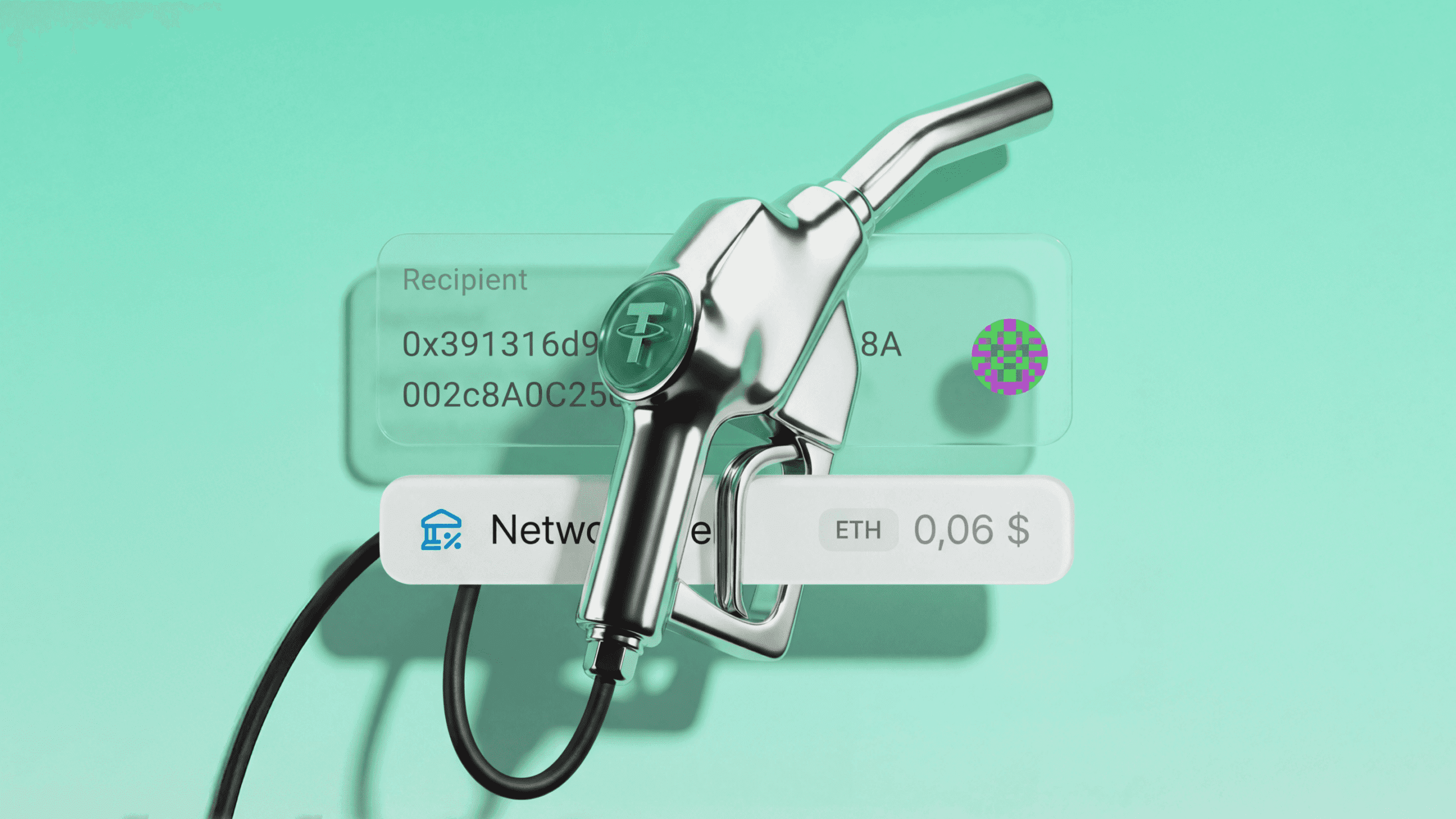
Smart Gas transactions are now live in the Tangem app on Ethereum, BNB Smart Chain, Polygon, Arbitrum One and Base. In short: if you hold USDC or USDT on one of those networks, you can pay the network fee in that stablecoin instead of hunting down a few dollars of ETH, BNB or POL first.
What a Smart Gas payment is
A Smart Gas payment lets you cover a transaction’s network fee with a stablecoin rather than the chain’s native token. When you have USDC or USDT on a supported network, the app can take the fee straight out of that balance.
A typical case: Alice withdraws 100 USDT from an exchange to her Tangem Wallet on Ethereum. She wants to send 50 USDT to Bob, but she has no ETH on the wallet to pay gas. The app notices her USDT balance and offers to pay the fee in USDT. Alice confirms and signs, 50 USDT goes to Bob, and roughly US$0.80 in USDT is deducted for the network fee. She never had to buy ETH.
Supported networks and tokens
Smart Gas works on the major EVM networks that have shipped EIP-7702 (the Pectra upgrade). The fee tokens were chosen for liquidity, predictable transfer costs and wide use, which in practice means the USD stablecoins people most often hold after withdrawing from an exchange.
| Network | Supported fee tokens |
|---|---|
| Ethereum | USDC, USDT |
| BNB Smart Chain | USDC, BSC-USD |
| Polygon | USDC, USDT0 |
| Arbitrum One | USDC, USDT0 |
| Base | USDC |
How a Smart Gas transaction works behind the scenes
The feature relies on EIP-7702 (“Set Code for EOA”), which arrived with the Pectra upgrade in May 2025. It changes what an ordinary Ethereum account is allowed to do.
How EIP-7702 works
Ethereum has always had two kinds of account. Externally Owned Accounts (EOAs) are controlled by a private key; they can hold assets and sign transactions but can’t run custom logic. Contract accounts can run arbitrary code, but they have to be deployed and they behave differently from a security point of view.
EIP-7702 lets an EOA temporarily borrow a smart contract’s code by signing an authorisation message. That authorisation doesn’t need its own on-chain transaction. You sign a message, and someone else can include that signature in a transaction they submit.
That is the piece that makes Smart Gas possible. You can attach Tangem’s contract logic to your account without paying any gas for the attachment itself.
Tangem’s smart contract implementation
Tangem wrote its own contract rather than adopting an existing one. The off-the-shelf options it evaluated were either more expensive for users because of overhead that wasn’t needed, or carried extra functionality that widened the attack surface without adding anything for this use case.
The implementation uses two contracts.
Tangem7702SmartGasExecutor
This is the contract your EOA delegates to. It handles three jobs:
- Signature verification. It checks that the Smart Gas parameters were signed by the account owner, using EIP-712 typed data signing.
- Transaction execution. It carries out what you actually asked for, such as a token transfer.
- Fee compensation. It works out the gas actually consumed and sends the matching amount of fee token to the fee recipient.
The contract keeps almost no storage, just a nonce for replay protection. Its storage layout is offset using Solidity’s custom storage layout feature, so nothing collides if you later attach a different contract to the same account.
One constant worth knowing: BASE_GAS is set to 60,000. That is the fixed overhead for signature verification, nonce updates and execution scaffolding.
Tangem7702EntryPoint
Tangem also deployed an Entry Point contract, which is how its relay submits Smart Gas transactions. Its job is narrow. Before forwarding a transaction, it checks that the code attached to your address is exactly the expected contract.
A forced parameter controls what happens if the fee transfer needs more gas than feeTransferGasLimit allows:
- false: revert the transaction (used during gas estimation)
- true: emit an event and carry on (used during real execution, since the gas has already been spent)
This protects the relay. Tangem pays the real gas up front and is repaid from your fee token balance, so it needs to be sure the attached contract will calculate and transfer that repayment correctly. The Entry Point guarantees the relay only ever deals with accounts running the audited code.
Fee parameters
When you approve a Smart Gas transaction, the message you sign contains:
- the fee token (USDC, for example)
- the token price, meaning the rate between the fee token and the native coin, used to work out the equivalent cost
- the maximum fee, which is the figure the Tangem app shows you and the most you can be charged
- replay-protection and transaction-specific parameters
The maximum fee is there so you know the worst case before you sign. The fee actually charged is based on real gas used and is usually lower.
Security model
Building a purpose-built contract was a security decision as much as a cost one. The contract does one thing, token transfers with fee payment, which makes it easier to audit and reason about.
| Factor | ERC-4337 | Tangem’s implementation |
|---|---|---|
| Gas overhead | Higher (bundler infrastructure) | Lower (direct execution) |
| Attack surface | Larger (more functionality) | Minimal (single purpose) |
| Storage collision risk | Varies by implementation | Mitigated via custom storage layout |
| Upgradeability | Often included (admin key risk) | Not upgradeable |
Audit
The contract was audited by Pessimistic, a firm that specialises in smart contract analysis. The full report is on GitHub.
What you see in the app
None of the machinery above is visible when you use it:
- You start a transaction (send, swap, or send via swap) on a supported network.
- If you hold a supported stablecoin there, the app offers to pay the fee in that token.
- You see the maximum fee in the stablecoin and confirm.
- With one tap of your card or ring you sign both the EIP-7702 authorisation (attaching Tangem’s contract to your account) and the Smart Gas parameters.
- The signed bundle goes to Tangem’s backend, which submits it to the network.
- The transaction executes and the fee comes out of your stablecoin balance.
From your side it looks like any other transaction. You just didn’t need native coins to make it happen.
Limitations
Smart Gas currently works only with the stablecoins in the table above. Two other things to be aware of:
- Fee premium. A Smart Gas transaction can cost slightly more than paying gas natively, because of the extra contract execution and the token price conversion. The contract has been tuned to keep that premium small.
- Network support. EIP-7702 only exists on chains that have implemented Pectra. Tangem has switched the feature on where both EIP-7702 support and stablecoin liquidity make it practical.
Why it matters for exchange withdrawals
Running out of gas with a wallet full of stablecoins has been one of the most common support questions we get from New Zealand customers moving funds off an exchange for the first time. With Smart Gas, the USDT or USDC you withdraw is spendable straight away. You don’t need to understand gas mechanics before you can move your own money.
Update to the latest Tangem app on iOS or Android to use it. If you don’t have a wallet yet, Tangem NZ is an authorised New Zealand seller with stock in Auckland and prices in NZ$ including GST.