Here’s the scenario worth avoiding. Your Tangem Ring arrives, you slide it on, and it’s half a size out: either it won’t clear your knuckle, or it spins loose enough that you’d lose it on a beach walk. With a gold band you’d take it to a jeweller on Monday. You can’t do that here. That’s what makes a proper Tangem Ring size guide worth reading before you order rather than after. The material can’t be resized, and every sizing chart Tangem publishes uses US numbers while every jeweller in New Zealand works in letters.
This guide converts between the two, shows you four ways to measure at home, and flags the four errors that account for most wrong-size orders.
Tangem Ring sizes
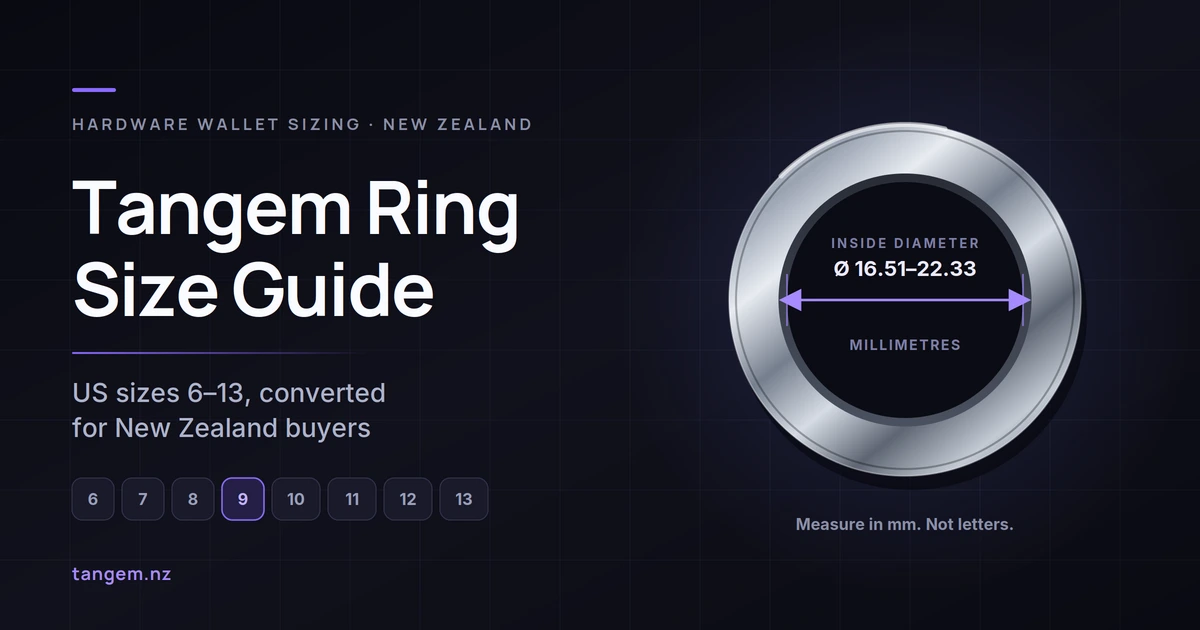
The Tangem Ring is produced in eight US sizes, 6 through 13, with inside diameters running from 16.51mm to 22.33mm. Tangem publishes a manufacturing tolerance of ±0.25mm, which comes from the polishing process. There are no half sizes.
The official chart, with the New Zealand and Australian letter equivalents added:
| US size | Inside diameter (mm) | Inside circumference (mm) | NZ/AU letter (approx.) |
|---|---|---|---|
| 6 | 16.51 | 51.87 | M |
| 7 | 17.35 | 54.51 | N½ – O |
| 8 | 18.19 | 57.15 | P½ – Q |
| 9 | 18.89 | 59.34 | R |
| 10 | 19.84 | 62.33 | T |
| 11 | 20.68 | 64.97 | V |
| 12 | 21.49 | 67.51 | X |
| 13 | 22.33 | 70.15 | Z |
Two things to know about that range. The first production drop in 2024 covered only sizes 8 to 13, so older reviews, Reddit threads and YouTube videos still quote six sizes rather than eight. If you have small hands, don’t take an outdated article’s word for it. Check what’s actually available.
Second, the ±0.25mm tolerance is smaller than the gap between adjacent sizes, which sit roughly 0.8mm apart. So tolerance won’t rescue a decision that’s a full size wrong, but it does mean a borderline call can land slightly either way.
Converting NZ ring sizes to Tangem’s US sizing
New Zealand and Australia use the UK alphabetical sizing system, so a local jeweller will tell you you’re a “Q” or a “T”, not a number. Convert through inside diameter in millimetres rather than a letter-to-number table, because that’s the one measurement both systems agree on.
Why millimetres beat size labels
The letter system runs in half-size steps, and published conversion charts disagree with each other by up to a third of a size at the edges. A chart that puts US 9 at R and another that puts it at R½ are both defensible. Neither helps when you only get one shot.
Millimetres remove the argument. Ask your jeweller for the inside diameter of the size they’ve measured you at, then match it against the middle column of the table above. If you’re told 19.0mm, you’re between US 9 (18.89mm) and US 10 (19.84mm), closer to 9, and that’s a real decision rather than a guess.
Quick reference for common NZ sizes
Most adult New Zealanders land somewhere between N and V on the letter scale for index and middle fingers. In Tangem terms:
- N to O is a US 7
- P to Q is a US 8
- R to S is a US 9
- T to U is a US 10
- V to W is a US 11
Treat these as starting points, not answers. The half-size boundaries are exactly where errors happen, which is why the next section matters.
Four ways to measure your ring size at home
You have four practical options: Tangem’s printable chart, measuring a ring you already own, a visit to a jeweller, or the string method. Their accuracy varies more than you’d expect, and the free option is not the worst one.
Tangem’s printable size chart
Tangem provides a printable sizing guide with circles and a paper sizer you cut out. It works well, with one condition that people skip: print at 100% scale with page scaling turned off, then check the printed ruler against a real one before you measure anything.
A printer defaulting to “fit to page” will shrink the sheet by a few percent. That’s enough to shift you a full size, and you’d never notice. If the printed ruler doesn’t match a real ruler exactly, reprint before going further.
A ring you already own
If you have a ring that fits the finger you’ll wear the Tangem on, this is quick and reliable. Measure the inside diameter, not the outside. Measuring the outside of the band overstates your size by roughly twice the band thickness.
Lay the ring on a flat surface and measure the inner edge-to-edge distance across the widest point with a ruler. Digital calipers do it properly and cost very little at any NZ hardware store. Take the reading three times and use the middle value.
A jeweller
Most NZ jewellers will size your finger for free with a set of steel sizing rings, which is more accurate than anything paper-based. Steel rings tell you whether it clears your knuckle, which is information no chart can give you.
One request when you go: ask for the inside diameter in millimetres as well as the letter size. Some staff will need to check their chart for it. It’s worth the extra minute.
String or paper strip
Wrap a non-stretchy strip around the base of your finger, mark the overlap, measure the length, and compare against the circumference column. It’s the least accurate approach. String stretches, tension varies, and a millimetre of slack throws the result. Use it as a cross-check rather than your primary measurement.
| Method | Accuracy | Cost | Time | Best for |
|---|---|---|---|---|
| Jeweller’s steel sizers | Highest | Usually free | 10 min + travel | Anyone with a prominent knuckle |
| Existing ring + calipers | High | Low | 5 min | People who already wear rings |
| Printed chart | Good, if scaled right | Free | 15 min | Ordering tonight |
| String or paper | Low | Free | 5 min | A second opinion only |
The sizing mistakes that cost NZ buyers a return
Most wrong-size orders trace back to four causes: measuring cold fingers, ignoring the knuckle, printing a chart at the wrong scale, and not accounting for band width. Three of the four are avoidable in under ten minutes.
Measure warm, and late in the day
Finger size isn’t fixed. Fingers run smaller when cold and larger after activity or heat. Measuring at 7am in an unheated Dunedin flat in July will give you a genuinely different reading than 8pm in February.
Measure at the end of the day, at normal room temperature, and repeat it on a different day before committing.
The knuckle problem
If your knuckle is noticeably wider than the base of your finger, the base measurement is the wrong number to order from, because the ring still has to pass over the knuckle. Measure both, then choose a size in between, leaning toward the knuckle measurement.
A ring that fits the base perfectly but won’t clear the knuckle is unwearable. One that clears the knuckle and sits slightly loose at the base is merely imperfect.
Band width changes the fit
Wider bands sit tighter than narrow ones at the same nominal size, because they contact more of your finger. This is why a size matched to a slim wedding band can still feel snug in a chunkier ring.
Build in room for real life
Gym sessions, hot weather, long-haul flights, manual work and pregnancy all change finger size temporarily. If you’re a tradie or you train regularly, size for your hands at their largest, not their smallest. A ring you can’t remove at the end of a hot day is a problem; a ring that’s slightly loose in winter is not.
Which hand and finger to wear it on
Wear it on the index or middle finger of the hand you don’t hold your phone with. You sign transactions by tapping the ring against the back of your handset, and that’s awkward if the ring is on the hand gripping the phone.
The Ring has no battery. It draws power from your phone’s NFC field, so contact position matters. On most Android phones the NFC antenna sits in the upper third of the back panel; on iPhones it’s near the top edge. A ring on your free hand lets you tap deliberately instead of contorting your grip.
For daily wear, Tangem publishes an IP69K rating for the Ring, covering water and dust ingress. That’s a strong rating, though it’s sensible to treat any wearable as something you’d rather not knock against concrete or bench weights.
The Tangem Ring can’t be resized
The Ring is made from a hard ceramic material (Tangem describes it as zirconium ceramic), not precious metal. Ceramic can’t be stretched on a mandrel or cut and re-soldered the way gold and silver can. No jeweller in New Zealand can adjust it. Your only remedy for a wrong size is an exchange.
The two backup cards soften the risk
Worth knowing before you panic: the set ships as one ring plus two cards, and all three devices carry the same private key. So a sizing mistake is an inconvenience, never a threat to your funds. You can set up and use your wallet from a backup card while an exchange is in progress, and you’re not locked out of anything.
That’s a meaningfully different situation from a single-device wallet, and it’s the reason a sizing error here costs you shipping time rather than access.
Exchanging a wrong size from New Zealand
This is where buying domestically earns its keep. An exchange with an overseas store means international return postage, a second customs clearance, and weeks of waiting. A local exchange is a domestic courier bag.
Buying the Ring as a gift
Don’t guess a size. Either borrow a ring they already wear and measure its inside diameter, or buy the Tangem card wallet instead and let them choose their own ring size later.
Two tactics that work: measure a ring from their jewellery box while they’re out, or ask a partner or sibling who’d know. If neither is available, the honest recommendation is the card set. It’s a better gift than a ring in the wrong size and an exchange form.
Our sizing recommendation
Take two independent measurements using different methods, work in millimetres throughout, and when you land between two sizes, go up rather than down. A slightly loose ring is wearable. A slightly tight one isn’t.
Before you order:
- Measure at the end of the day, at room temperature
- Use two different methods and compare the results in mm
- If you have a prominent knuckle, measure it too and size between
- Check your figure against the inside-diameter column in the chart above
- Round up when you’re between sizes
- Confirm the size you want is currently in stock before you commit
You can check which sizes are currently available at Tangem NZ, with local stock and NZ shipping.
FAQs
What size Tangem Ring should I get?
Measure your finger’s inside diameter in millimetres and match it to the chart. Sizes run US 6 (16.51mm) to US 13 (22.33mm). If you fall between two, choose the larger. Measure late in the day at room temperature for the most representative reading.
What’s my NZ ring size in US sizing?
Roughly: N–O is a US 7, P–Q is a US 8, R–S is a US 9, T–U is a US 10, and V–W is a US 11. Because letter charts vary, confirm by asking your jeweller for the inside diameter in millimetres and matching that instead.
Can the Tangem Ring be resized?
No. It’s a hard ceramic material rather than precious metal, so it can’t be stretched or cut and rejoined. If the size is wrong, an exchange is the only option, which is why measuring twice before ordering is worth the effort.
What happens if the Tangem Ring doesn’t fit?
You can return or exchange it under the seller’s returns policy, and your funds stay accessible through the two backup cards in the meantime. Buying from a New Zealand seller keeps the exchange domestic instead of shipping internationally twice.
Does the Tangem Ring come in half sizes?
No, the range is whole US sizes 6 to 13. Adjacent sizes are about 0.8mm apart in inside diameter, so if you sit exactly between two, size up.
Which finger should I wear the Tangem Ring on?
Index or middle finger of your non-phone hand works best, since you tap the ring against the back of your handset to authorise transactions. Choose the finger you measured. A size that fits your ring finger won’t necessarily fit your index.
Can I shower or swim with the Tangem Ring?
Tangem publishes an IP69K water and dust rating for the Ring, so ordinary water exposure isn’t a concern. As with any wearable, it’s still worth avoiding hard knocks against solid surfaces.