At some point the number in MetaMask stops feeling like play money. Maybe it happened when ETH ran, or when you added up your tokens in NZD for the first time in a year. Either way, the realisation is the same: a meaningful amount of your money is sitting behind a browser extension on a machine that also opens email attachments.
Move Crypto From MetaMask to Tangem Wallet Safely
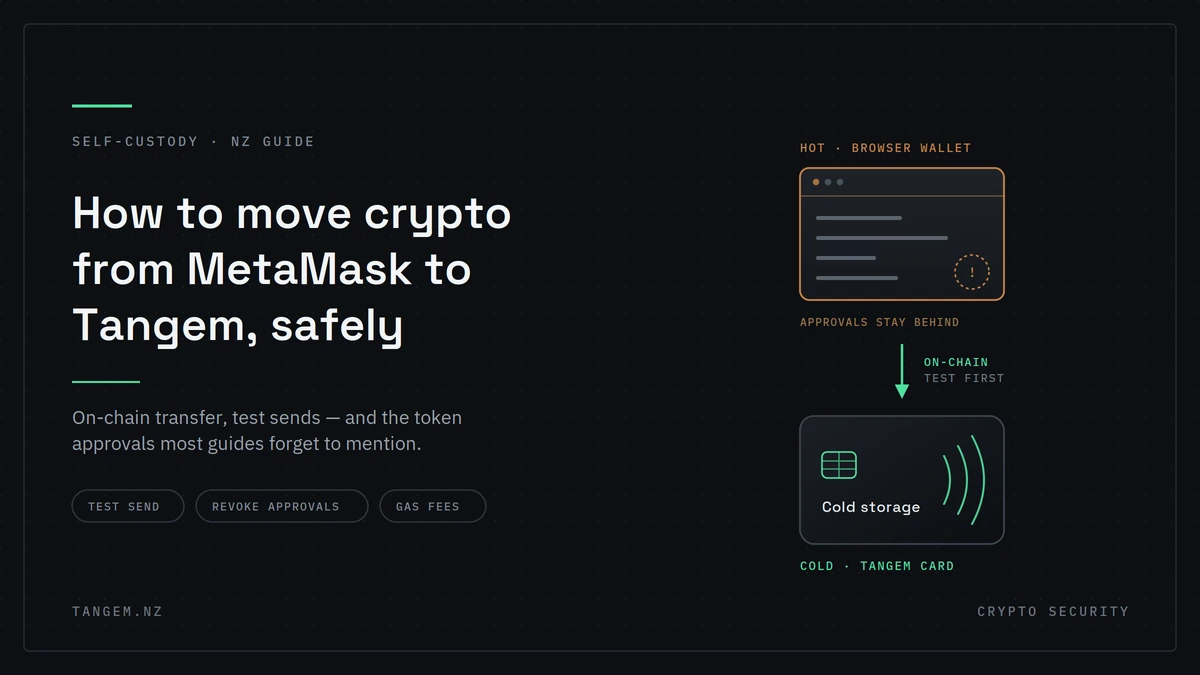
Moving crypto from MetaMask to a Tangem wallet safely is a straightforward on-chain job, but the transfer itself is the easy part. What most guides skip is what stays behind in MetaMask after your balance leaves, and that’s where people actually get burned.
The safe way to do it, in short
Set up and fully back up your Tangem card set first. Copy the Tangem receiving address for the exact network you’re sending on, send a small test amount, confirm it arrives in the app, then send the rest. Finish by revoking the token approvals still attached to your old MetaMask address.
That last step takes five minutes and is the one people skip. We’ll come back to why it matters.
Send on-chain, or import your seed phrase?
You have two routes. You can send your assets to fresh addresses generated on the Tangem chip, or you can import your existing MetaMask seed phrase into the Tangem app so both wallets share the same addresses. For nearly everyone, the on-chain transfer is the right call.
Tangem supports seed phrase import, so plenty of people assume it’s the shortcut. It works. But think about what you’d be doing: taking twelve words that have lived inside a browser extension (typed on a laptop, possibly backed up in a photo, exposed to every extension you ever installed) and treating them as your permanent cold storage key.
A seed phrase can’t be un-exposed. Once it has touched an internet-connected device, you can’t prove it’s still private. Hardware doesn’t fix that; it just puts a good lock on a door someone may already have a copy of the key to.
Why an on-chain transfer is the better default
When you create a wallet on a Tangem card, the chip generates the private key itself, offline, and it can’t be exported. There’s no phrase to lose, photograph or type into a phishing page. That is the core of the argument in our comparison of seed phrase and seedless wallets.
Cost: some gas. Time: usually minutes. What you get is an address with no history of browser exposure.
When importing makes sense
There are genuine reasons to keep an address. An ENS name you’ve built a reputation around. An address hard-coded into a multisig, a payroll setup or a vesting contract. A long on-chain history that matters for a DAO or an allowlist.
If that’s you, importing is a reasonable choice. Just understand you’re carrying forward the old key’s exposure. And if MetaMask has ever thrown a security warning, or you’ve ever entered that phrase on a website for any reason, don’t import it. Move on-chain and leave the old address behind.
| On-chain transfer | Seed phrase import | |
|---|---|---|
| Private key origin | Generated on the Tangem chip, never exported | Reuses a key that existed in a browser |
| Cost | Network fees per asset, per chain | No gas to import |
| Time | Minutes to an hour, depending on holdings | A few minutes |
| Address continuity | New addresses; ENS and history stay behind | Keeps your existing addresses |
| If MetaMask was ever compromised | Old address is isolated; new funds unaffected | Compromise follows you onto the hardware |
| Token approvals | Left behind with the old address | Come with you, still active |
| Best for | Most holders consolidating into cold storage | Users tied to a specific address for a specific reason |
Five checks before you send anything
Ten minutes of preparation prevents the mistakes that cost real money. Do these in order before a single transaction leaves MetaMask.
- Set up and verify the Tangem backup properly. Link all cards in the set, set an access code, and confirm each card can open the wallet on your phone before you fund it. A backup you haven’t tested isn’t a backup.
- Inventory what you actually hold. Scroll past the top three tokens. Check every network you’ve used: Arbitrum, Base, Polygon, BNB Chain. Forgotten dust on a forgotten chain is how people lose track of assets.
- Exit staked, wrapped and LP positions first. Receipt tokens, LP tokens and locked staking positions don’t always behave like ordinary ERC-20s. Unstake and unwrap while you still control the address, and check each protocol’s own withdrawal process.
- Confirm you have gas on every network. Each chain needs its own native token to pay fees. Running out mid-transfer with tokens still stranded is annoying and avoidable.
- Check you’re on the genuine MetaMask extension. Clone extensions exist. Confirm the publisher and update it before you start.
Moving your assets across, step by step
The sequence matters more than the individual steps. Copy the address for the right network, prove it works with a small amount, then move the bulk and send your gas token last.
- Open the Tangem app and tap your card. Select the specific coin or network you’re receiving on and copy that receiving address. EVM chains share one address, but you still confirm the network each time.
- Verify the address visually. Read the first six and last six characters against what’s displayed in the Tangem app. Don’t trust the paste alone. Clipboard malware exists, and so does address poisoning (more on that shortly).
- Send a test transaction. NZ$5 to NZ$20 of value is plenty. It costs an extra fee, and it’s the cheapest insurance in crypto.
- Confirm it lands in the Tangem app, not just on Etherscan. Seeing the balance in the app you’ll actually use proves the whole path works end to end.
- Send your tokens next, then your native gas token last. Every ERC-20 transfer costs ETH. Send all your ETH first and you’ll be stuck holding tokens you can’t move.
- Repeat per network. Same address on EVM chains, separate transaction each time. Take care that you’re sending a token on the network Tangem is expecting.
- Leave a small gas buffer in MetaMask until you’ve finished the cleanup below.
What gets left behind in MetaMask and why it matters
Moving your balance does not move your permissions. Every time you approved a dApp to spend a token, you granted a contract ongoing spending rights on that address, and those approvals stay live after the balance hits zero.
This is the part almost nobody covers, so be clear on the risk. An empty address with active approvals is harmless while it’s empty. The moment anything lands there (an airdrop, a refund, a mistaken send), an old or malicious contract can move it.
Review and revoke your token approvals
Go through the approvals attached to your old address and revoke anything you no longer use, particularly unlimited allowances. Each revocation is a transaction and costs gas, which is why you kept that buffer. Prioritise approvals on tokens you actually held, and anything granted to a protocol you don’t recognise.
NFTs transfer separately
NFTs don’t move with your token balance. Each collection is its own transfer, sometimes one token at a time, and gas adds up on mainnet. Check the collection is supported in the Tangem app before you send, and test with the least valuable item you own.
Decide whether to retire the address
Two reasonable positions:
- Keep it as a hot wallet. Fund it with small amounts for dApp use, minting and experiments. Your cold storage never touches a browser. This is what most experienced holders do.
- Retire it completely. Empty it, revoke everything, remove it from your day-to-day. Cleaner, but you lose a convenient sandbox.
Either is fine. What isn’t fine is leaving it half-funded with live approvals and forgetting about it.
Address poisoning and other traps during a transfer
The transfer window is when you’re most exposed, because you’re copying addresses under mild pressure and telling people what you’re doing. A few specific attacks target exactly this moment.
- Address poisoning. An attacker sends a zero-value or dust transaction from an address that looks almost identical to yours, with the same first and last characters. It appears in your transaction history, and later you copy it from there instead of from the app. Always copy from the Tangem app, never from history.
- Fake support and “migration assistants.” Post about moving to a hardware wallet on any social platform and you’ll get helpful replies. Tangem doesn’t have DM support agents who need your details.
- Clipboard hijacking. Malware that silently replaces a copied address. Visual verification defeats it.
- Seed phrase phishing. With a hardware-generated Tangem wallet there’s no seed phrase to give away. Any app, site or person asking you for one is a scam. No exceptions, and no “verification process”.
Fees, timing and the New Zealand tax question
Costs depend on which network you’re on and how busy it is, not on which wallet you’re sending to. Layer 2s cost a small fraction of Ethereum mainnet. The tax position for a wallet-to-wallet move is usually simpler than people fear, but it depends on what you do during the move.
What the move actually costs
Budget for one fee per asset per network, plus one per revocation. On Ethereum mainnet at a busy moment, a handful of token transfers can add up; on Arbitrum, Base or Polygon the same work is typically cents. If you’re moving between chains anyway, doing it when mainnet is quiet is worth the wait.
Worth knowing for afterwards: Tangem’s Smart Gas feature lets you pay network fees with stablecoins on several networks including Ethereum, BNB Smart Chain, Polygon, Arbitrum One and Base, which removes the “stranded tokens, no gas” problem going forward.
Is moving crypto between your own wallets taxable in NZ?
Generally, transferring crypto assets between wallets you control isn’t a disposal, because you haven’t sold or exchanged anything. You still hold the same assets. What can create a taxable event is swapping or consolidating assets during the process, or unwinding a staking or LP position on the way out.
Keep records regardless: dates, amounts, both addresses, transaction hashes and NZD values at the time. Inland Revenue expects you to be able to show your cost base, and reconstructing it two years later is miserable.
This is general information, not tax advice. If you hold a significant position, trade frequently, or run any of this through a business or trust, talk to an accountant who handles crypto.
A short checklist for after the move
Finish properly and you won’t need to think about this again for a long while.
- Confirm every card in the set opens the wallet, then store them in separate physical locations.
- Set an access code and make sure you can recall it without a note stored on your phone.
- Verify all balances appear correctly in the Tangem app.
- Revoke remaining approvals on the old address.
- Do one small test send out of Tangem to an address you control. Learn the exit path before you need it in a hurry.
- Note which networks hold what, so future-you isn’t hunting for a forgotten token.
FAQs
Can I import my MetaMask seed phrase into a Tangem wallet?
Yes, Tangem supports importing an existing seed phrase. We’d generally advise against it. A phrase that has lived in a browser extension can’t be proven private again, and importing carries that exposure onto your hardware. Sending on-chain to a chip-generated key is the cleaner option.
How long does it take to move crypto from MetaMask to Tangem?
For a simple holding of ETH and two or three tokens on one network, around 15–30 minutes including a test transaction. Multiple chains, NFTs or DeFi positions can stretch it to an hour or more. Don’t rush it, and don’t do it at 11pm.
Do I need to move each token separately?
Yes. Every token is its own transfer with its own fee, on every network. There’s no bulk-send in a standard wallet transfer, which is one reason people consolidate onto fewer chains first.
Will my NFTs transfer to Tangem?
NFTs move as individual transfers, separately from your token balances. Check that the collection and network are supported in the Tangem app before sending, and test with a low-value item first.
What happens to my DeFi positions and staked tokens?
Exit them before you transfer. Staking receipts, LP tokens and wrapped positions don’t reliably behave like ordinary tokens, and some are tied to the address that created them. Unstake and unwrap through the protocol while you still control the MetaMask address.
Is it safe to keep using MetaMask after moving to Tangem?
It’s a common setup: MetaMask as a small hot wallet for dApps, Tangem for the bulk of your holdings. Just keep the balance low, revoke stale approvals, and never fund it from your cold storage in large amounts.
Do I pay tax in NZ for moving crypto between my own wallets?
A transfer between wallets you control generally isn’t a disposal, since you haven’t sold or swapped anything. Swaps or consolidations made during the move can be. Keep full records and check current IRD guidance or ask an accountant about your situation.
If you’re still choosing a set, Tangem NZ is an authorised New Zealand seller with stock in Auckland and NZ$ pricing including GST. If you get stuck partway through a move, get in touch and we’ll talk you through it. We’ll never ask for your access code or a seed phrase.