Two adults, some crypto sitting on an exchange, and a quiet realisation: if something happened to one of you, the other wouldn’t have the first idea how to reach it.
Tangem Family Pack Setup
That’s the actual reason most families start looking at hardware wallets. It’s also why the Family Pack is a two-wallet product rather than a bigger card set. The setup that works for a household isn’t one wallet shared around; it’s several wallets with clear boundaries. Getting that structure right at the start takes about fifteen minutes of thinking. Getting it wrong means rebuilding everything later, moving funds between wallets, and paying network fees to fix a decision you could have made properly on day one.
This is how to plan it before you tap a single card.
The mistake almost every family makes first
The cards in a Tangem set are identical keys to one wallet, not separate accounts. So the instinctive plan (buy a 3-card set, hand one card to each family member) gives all three people complete control of the same funds. It’s not a family setup. It’s one wallet with three people holding the master key.
This trips up almost everyone, because the packaging looks like it contains three wallets. It doesn’t. It contains one wallet and three ways in.
What “one wallet, three cards” actually means
The cards are cut copies of the same house key. Any one of them opens the front door completely. There’s no version of the key that only opens the hallway.
In practice that means anyone holding any card from the set, plus the access code, can send every coin in that wallet anywhere. There’s no per-card limit, no per-card balance, no read-only card. That design is exactly what makes recovery so simple: lose a card and the others still work, with no seed phrase to hunt down. But it also means card count is a redundancy decision, never a sharing decision.
When splitting a card set is the right call
There’s one legitimate exception, and it’s a good one: two adults who hold jointly and want mutual access.
If you and your partner treat your crypto as shared property and both want to be able to reach it without asking, one wallet with a card each is a sensible arrangement. You’re not dividing anything. You’re deliberately giving two people the same complete access, which is what a joint account does. Just be clear that’s the decision you’re making.
The three-layer family setup that works
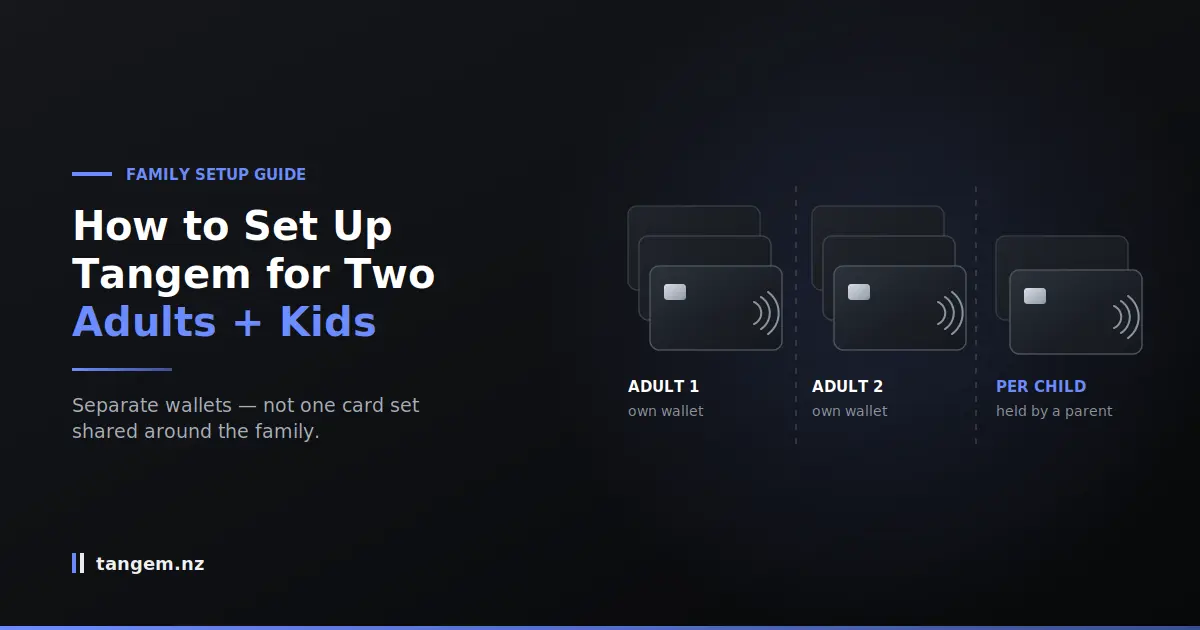
A household usually needs three distinct layers: a personal wallet for each adult, one shared wallet both adults can reach, and a custodied wallet per child. Each layer answers a different question about who should be able to move what, and mixing them into a single wallet is what causes trouble later.
Layer one is a personal wallet for each adult
Each adult gets their own wallet with its own access code. Not because of secrecy, but because independence is the point of self-custody. Your holdings, your keys, your decisions. If one of you loses a card or forgets a code, it doesn’t touch the other person’s funds.
This is exactly what the Family Pack’s two wallets map onto. Two adults, two independent wallets, one purchase.
Layer two is the shared household wallet
Then a joint wallet: the household’s shared crypto, with an access code both adults know. Long-term savings, a shared position, funds either of you might need to move.
This is the layer that quietly solves the problem you started with. If one of you is unavailable (travelling, unwell, or worse), the other can reach the shared money without needing anything from you. Not everything, just the joint layer, which is usually the part that matters in a hurry.
Layer three is a custodied wallet per child
A separate wallet per child, held and controlled by a parent, earmarked for that child and handed over at an age you decide.
Be clear-eyed about the legal reality here. Until your child is an adult, this is functionally your wallet with your child’s name on it. NZ crypto on-ramps and exchanges require identity verification and are adult-only, so buying, selling and swapping stays with you regardless of whose name is on the wallet. What the separate wallet gives you is clean accounting and a clean handover: one day you give them the cards and the code, and the wallet is simply theirs. No untangling, no working out which portion of a shared balance was ever meant for them.
Which Tangem configuration suits your household
Match the structure to your household first, then buy. A single card set split among family members creates shared control nobody intended. The Family Pack’s two wallets cover two adults properly, and children’s wallets are added as separate sets alongside.
| One 3-card set, split among family | Family Pack (two wallets) | Family Pack + a set per child | |
|---|---|---|---|
| Who can access what | Everyone controls everything | Each adult controls their own | Each adult and each child’s funds separated |
| Privacy between members | None | Full between adults | Full throughout |
| If one card is lost | Remaining cards still work | Remaining cards in that wallet work | Same, per wallet |
| Suits a joint-finances couple | Yes, if that’s intended | Yes, add a shared wallet later | Yes |
| Handover to a child later | Messy; funds must be moved | Not covered | Clean; hand over cards and code |
| Indicative NZD cost | $139.99 | $279.60 | $279.60 + $109.99–$139.99 per child |
| Best fit | A couple who hold jointly | Two adults wanting independence | Families planning for kids’ handover |
Setting it up, step by step
Each wallet takes roughly three minutes to initialise, and you should do them one at a time. The part that needs actual thought happens before you tap anything: deciding your layer structure, who holds which cards, and what the access codes are.
Before you tap anything
Sit down together and settle five things:
- How many wallets. Count your layers, not your family members.
- Who holds the primary card for each wallet.
- Where each backup card goes. A specific location, not “somewhere safe”.
- The access code for each wallet, decided deliberately rather than improvised mid-setup.
- Who else needs to know each wallet exists, and how they’d find out.
Fifteen minutes here saves a rebuild later.
Creating each wallet in the app
Complete one wallet fully before you open the next box: initialise it, add its backup cards, set its access code, and confirm it appears correctly. Setting up several at once is how cards end up in the wrong envelope.
Name each wallet something that will still make sense in five years. “Sarah personal”, “Household savings”, “Mia handover at 18”. Not “Wallet 1” and “Wallet 2”. You are writing these labels for a future version of yourself under stress, or for your partner reading them for the first time without you there to explain.
Access codes, the part families get wrong
Three rules, and the third is the one people break:
- A separate code per wallet. Reusing one code across all of them collapses your careful separation back into a single point of failure.
- Both adults know the shared wallet’s code. That layer is pointless if only one of you can open it.
- Never store the code with the cards. A card in a drawer with the code written beside it is a single object that hands over everything. Card in one place, code in another. That’s the entire security model, and it’s easy to accidentally defeat.
Where to store the backup cards in a New Zealand home
Backup cards need real geographic separation, not a different drawer in the same house. The test is simple: if one event (a burglary, a fire, a flood) could reach every card you own, your backups aren’t backups.
The single-point-of-failure test
Walk through it honestly with your own house in mind.
- A break-in. Thieves clear the master bedroom and the office desk. Were all your cards in those two rooms?
- A house fire. Everything inside is gone. Is a single card anywhere else?
- A flood. Auckland has shown what a bad night of rain does to ground floors. Anything stored low is at risk.
- A significant earthquake. The building may be unenterable for weeks. Can you reach a card that isn’t inside it?
Tangem cards are built to survive water, dust and temperature extremes far better than paper, so the card itself is resilient. The risk is losing access to the place, not damage to the card.
Safe deposit options and what to avoid
Reasonable options: a bank safe deposit facility, a fire-resistant safe bolted down at a second property, or a trusted family member’s home in a different suburb or city. If you use someone else’s house, they hold a card, not the access code. Neither piece is useful alone.
Avoid, without exception: photographing your cards or codes, storing a code in your notes app, emailing details to yourself, or putting anything in cloud storage. The reason a seedless wallet is stronger than a written seed phrase is that nothing sensitive exists in copyable form. A photo puts it back.
What happens if something happens to you
This is the section most wallet guides skip, and it’s the one families actually need. Self-custody means there’s no support line, no account recovery, no institution holding a record. If nobody knows the cards exist and how to use them, the crypto is unreachable permanently.
A letter of instruction that doesn’t leak your keys
Write a document that explains the shape of the setup without containing the keys to it:
- That crypto exists, roughly what and roughly where
- That access requires a physical Tangem card plus an access code
- Where each card is stored, in terms a trusted person could follow
- That the Tangem app is free and works on any compatible phone
- Who to ask for help: a named person who understands it
What it must not contain: the access codes themselves. Store it with your important documents, referenced from your will rather than written into it, since a will can become a public document once probate is granted.
Teaching your partner enough to actually recover it
Do one dry run. Have your partner tap a card, open the app, and look at a balance with you in the room, and with them doing the tapping, not watching you do it.
Ten minutes, once. It’s the difference between a plan that exists on paper and one that works.
Teaching kids with a wallet they can actually use
If the goal is education rather than accumulation, give a child a separate low-value wallet where mistakes cost almost nothing. Small amounts, real mechanics. A wallet holding meaningful savings is the wrong place for a first lesson.
Age-appropriate steps and what to hold back
A reasonable progression:
- Tap and look. They tap the card, see a balance, learn that the card is the key and the phone is just a screen.
- Receive. Someone sends them a small amount and they watch it arrive. Addresses, confirmations, waiting.
- Send small. Supervised, tiny, with a deliberate discussion of the fact that a mistyped address is unrecoverable.
- Understand the responsibility. Lose the cards and forget the code, and nobody can help. That lesson lands better on a wallet holding lunch money.
What stays with you: buying, selling and swapping. NZ on-ramps require identity verification and are adult-only, so those steps are the parent’s regardless of whose wallet it is.
Pros and cons of the multi-wallet family approach
In favour:
- Each person’s funds are separate, with no accidental shared control
- A shared layer either adult can reach without the other
- Clean handover to a child later, with no moving funds and no untangling
- One wallet compromised or lost doesn’t expose the rest
- Seedless setup means nothing written down for a child to find or a burglar to photograph
Against:
- Costs more than a single card set
- More cards to track and more access codes to remember
- Every wallet needs its own storage plan, not just the first one
- Requires a real conversation between two adults about who controls what
- Children’s wallets remain parent-controlled in practice, which may not match how it was described to the child
FAQs
Can two people share one Tangem wallet?
Yes, and for a couple who hold jointly it’s a sensible arrangement: each person keeps a card from the same set and both have full access. Just understand that access is complete and equal, with no way to limit what either person can move.
Can I give a Tangem card to my child?
You can physically hand a child a card, but treat it as a wallet you control on their behalf until they’re an adult. Buying, selling and swapping through the app’s integrated providers requires adult identity verification, so those steps stay with you.
What happens to our family’s crypto if both parents die?
Nothing automatically. There’s no institution holding a record and no support line to call, so it’s reachable only if someone knows the cards exist, where they are, and how to use them. A written letter of instruction stored with your important documents is what prevents a permanent loss.
Should each child have their own wallet, or just an earmarked portion of ours?
A separate wallet per child makes the eventual handover clean: you pass over the cards and the code, and it’s simply theirs. Earmarking a portion of a shared wallet means moving funds later and paying network fees to do it.
Where should we store our backup Tangem cards?
In separate locations, so no single burglary, fire or flood can reach all of them. A bank safe deposit facility or a trusted relative’s home in another suburb both work. Never store an access code alongside a card, and never photograph either.
Does my child need their own phone to use a Tangem wallet?
No. The phone is only an interface and stores nothing sensitive, so any compatible smartphone with the free app will do, including yours. That makes supervised use straightforward while they’re learning.
Is cryptocurrency held for a child taxable in New Zealand?
Tax treatment depends on how and why the assets were acquired and who is considered to hold them, and gifting has its own considerations. This needs an answer from a chartered accountant rather than a wallet retailer.
The Tangem Family Pack is NZ$279.60 including GST from Tangem NZ, an authorised New Zealand seller with stock in Auckland. If you’d like a hand working out how many wallets your household needs, get in touch before you order.