You open your exchange app and check your balance. It’s grown more than you expected. Then a quieter thought follows: what if this exchange disappeared tomorrow? New Zealanders have seen it happen before. When Christchurch-based Cryptopia was hacked in 2019 and went into liquidation, customers waited years to get anything back.
So, what is the safest way to store crypto in NZ? There isn’t one answer for everyone. It depends on how much you hold, how long you’ll hold it, and which risks matter most to you. But there is a clear, practical approach that works for most people, and this guide walks you through it.
The short answer
For most New Zealanders, the safest way to store crypto long term is self-custody on a hardware wallet with properly stored backups, keeping only a small spending amount on an exchange or phone app. Your own habits matter just as much: secure backups, avoiding scams and a plan for your family.
In practice, that means:
- Long-term holdings in a hardware wallet that you control.
- Backups stored in separate places.
- A small amount on an exchange or app for buying, selling and spending.
- A written plan so your family can access it if something happens to you.
What you’re actually protecting against
Storing crypto safely means defending against five different risks: the company holding it failing or being hacked, scammers tricking you, losing your own access, physical disasters destroying your backups, and your family being unable to reach it if something happens to you. Different storage options protect against different risks.
- Exchange failure or hacks. If a company holds your crypto, you depend on its security and its finances.
- Phishing and scams. Fake websites, fake apps and fake support agents trick people into handing over access.
- Losing your own access. Lost devices, forgotten access codes or a misplaced seed phrase.
- Physical disasters. Earthquakes, floods and house fires can destroy backups kept in one place.
- Death or incapacity. Without a plan, your crypto can become impossible for your family to reach.
No single option removes all five risks. The aim is to cover each one sensibly.
Your storage options compared
There are five common ways to store crypto, from leaving it on an exchange to using a hardware wallet or multisig setup. Exchanges are the most convenient but carry company risk. Hardware wallets give you control, with more responsibility. The right choice depends on how much you hold and how comfortable you are managing your own security.
| Option | Who holds the keys | Main risks | Convenience | Best for |
|---|---|---|---|---|
| Crypto exchange account | The exchange | Exchange failure or hack; account takeover | Very high | Buying, selling and small amounts |
| Mobile hot wallet (app) | You, on your phone | Phone malware, phishing, losing your phone or seed phrase | High | Small spending amounts |
| Hardware wallet with seed phrase | You, on a device | Seed phrase theft or loss, phishing | Medium | Long-term holdings, experienced users |
| Seedless hardware wallet (e.g. Tangem) | You, on cards or a ring | Losing all your devices, scams that trick you into approving transactions | Medium to high | Long-term holdings, people who don’t want to manage a seed phrase |
| Multisig (several keys) | You, spread across several devices or people | Complexity and set-up mistakes | Low | Large holdings, advanced users |
The big shift happens between the first row and the rest. On an exchange, someone else controls your crypto. In self-custody, you do.
Keeping crypto on an NZ exchange: what you should know
NZ crypto exchanges are registered businesses with anti-money-laundering obligations, but that isn’t the same as protecting your balance. There’s no dedicated crypto licence, and crypto held on an exchange isn’t a bank deposit. If an exchange fails or is hacked, getting your crypto back can be slow and uncertain.
How NZ exchanges are regulated
- No standalone crypto licence. New Zealand doesn’t have a dedicated licensing regime for crypto exchanges.
- Registration and anti-money-laundering rules. Exchanges register on the Financial Service Providers Register, and businesses that exchange, transfer or hold crypto for customers are reporting entities under the AML/CFT Act, mostly supervised by the Department of Internal Affairs.
- Tax reporting. From 1 April 2026, crypto service providers collect and report customer information to Inland Revenue under the OECD’s Crypto-Asset Reporting Framework.
- FMA oversight is limited. The Financial Markets Authority gets involved mainly where crypto products count as financial products, such as some derivatives or managed funds.
These rules focus on money laundering and tax, not on guaranteeing your crypto if something goes wrong.
The Cryptopia lesson
Cryptopia, a Christchurch-based exchange, was hacked in January 2019 and went into liquidation. In 2020, the High Court ruled that the crypto held belonged to customers on trust, but the liquidation process took years. Most NZ exchanges have stronger security today, but the lesson remains: if a company holds your keys, its problems become yours.
When an exchange is reasonable
- Buying and selling. You’ll usually need an exchange to convert between NZ dollars and crypto.
- Small, active amounts you trade regularly.
- Short periods, before you move your crypto to your own wallet.
If you do keep crypto on an exchange, use a strong unique password, an authenticator app for two-factor authentication rather than SMS, and withdrawal address allowlists where available.
Why self-custody is safer for long-term holdings
With self-custody, you hold the keys to your crypto yourself, so no exchange failure, freeze or hack can take it. In exchange for that independence, you become responsible for your own security: backups, avoiding scams and planning for your family.
What self-custody removes:
- Exchange failure and liquidation risk
- Exchange hacks that drain customer funds
- Account freezes you can’t control
What you take on:
- Backups. Losing every way back into your wallet means losing your crypto.
- Scam awareness. Nobody can reverse a transaction you approve.
- Inheritance planning. Your family needs a clear path to your crypto.
For long-term holdings, most people are better served taking on these manageable responsibilities than depending on a company’s security and solvency. A hardware wallet makes it practical.
Hardware wallets: seed phrase or seedless?
Both types keep your keys offline, away from internet threats. A seed phrase wallet backs up with 12 or 24 words that work in many wallet apps, but those words can be stolen or lost. A seedless wallet like Tangem backs up with extra cards or a ring instead, so there are no words to phish.
| Seed phrase hardware wallet | Seedless hardware wallet (Tangem) | |
|---|---|---|
| Backup | 12 or 24 words on paper or metal | Two or three cards, or a ring, holding the same key |
| Biggest risk | Someone finding or phishing the words | Losing every device |
| Portability of backup | Restore in many compatible wallets | Restore with your other Tangem devices |
| Ease of use | Screen, buttons and a phrase to manage | Tap a card to your phone and enter an access code |
| Best for | Experienced users comfortable storing a phrase securely | People who want simple backups without managing words |
There’s no wrong choice between them. The right one is the backup you’ll actually manage well. Tangem also offers an optional seed phrase if you want both.
The layered approach we recommend
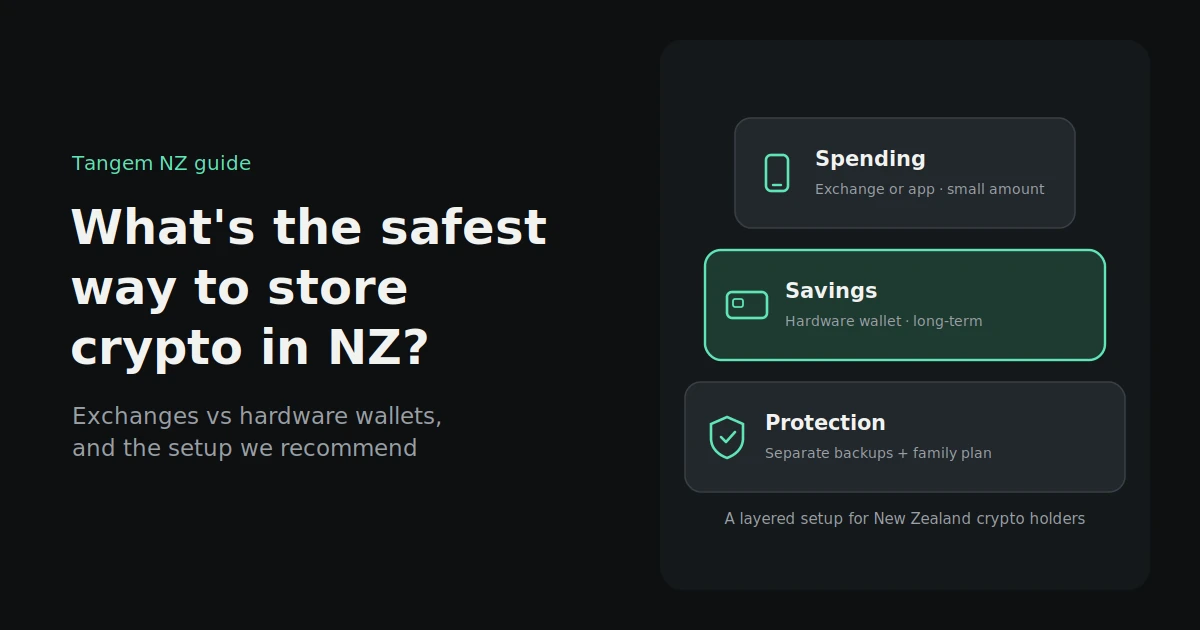
Don’t keep everything in one place. Keep a small, convenient spending layer on an exchange or phone app, put your long-term savings in self-custody on a hardware wallet, and protect both with separate backups and a family plan. Each layer handles a different risk.
| Layer | Where | What goes there | Why |
|---|---|---|---|
| Spending | Exchange account or mobile wallet app | A small amount you trade or spend | Convenience, accepting some extra risk |
| Savings | Hardware wallet in self-custody | Long-term holdings | Removes exchange risk and keeps keys offline |
| Protection | Backups in separate places, plus a written family plan | Spare cards or seed phrase, and instructions | Covers loss, disasters and inheritance |
How much belongs in each layer is your decision. A useful rule of thumb: if losing your exchange balance overnight would seriously hurt, too much is sitting there.
NZ-specific things to get right
In New Zealand, three things deserve extra attention: storing backups in separate places in an earthquake-prone country, keeping good records for Inland Revenue, and watching for scams that target local crypto holders, including fake police and wallet support.
Backups in an earthquake-prone country
Earthquakes, floods and house fires can destroy everything kept in one place. Store your backup cards, ring or seed phrase in separate locations: one at home, one off-site with trusted family, ideally in a different town, or in a safe deposit box.
Records for Inland Revenue
Keep a record of your crypto transactions, including purchases, sales, swaps and transfers between your own wallets, with dates, amounts and NZ dollar values. Moving crypto from an exchange to your own wallet is generally a transfer rather than a sale, but tax treatment depends on your circumstances. Check Inland Revenue’s crypto-asset guidance, or ask a tax adviser.
Scams targeting NZ crypto holders
In July 2026, NZ Police and the National Cyber Security Centre warned that scammers were impersonating police and crypto wallet support to target holders. Genuine police and wallet providers will never ask for your seed phrase, access code or remote access to your phone. If you’re targeted, report it to NZ Police on 105 or the NCSC on 0800 114 115.
A 10-step checklist for safer crypto storage
Use this checklist to move from “it’s on an exchange” to a setup that protects you against the most common risks.
- Decide your layers: a small spending amount, with the rest in long-term savings.
- Get a hardware wallet from the manufacturer or an authorised seller, new and sealed.
- Choose your backup type, seed phrase or seedless, and set it up during wallet creation.
- Test every backup before you send any funds.
- Send a small test amount from the exchange first, then the rest.
- Store backups in separate places, at least one off-site.
- Secure your exchange account with a unique password and app-based two-factor authentication.
- Keep transaction records for Inland Revenue.
- Write a family plan explaining what you hold, where the backups are and how to get help.
- Never share your seed phrase or access code with anyone, including people claiming to be support or police.
FAQs
What is the safest way to store crypto in NZ?
For most people, it’s self-custody on a hardware wallet for long-term holdings, with backups stored in separate places and a plan for your family. Keep only a small spending amount on an exchange or phone app.
Is it safe to keep crypto on an NZ exchange?
NZ exchanges are registered businesses with anti-money-laundering obligations, but there’s no dedicated crypto licence, and crypto on an exchange isn’t a bank deposit. For small, active amounts it’s reasonable; for long-term holdings, self-custody removes exchange risk.
Is a hardware wallet worth it?
If you hold an amount you’d be upset to lose, usually yes. A hardware wallet keeps your keys offline and removes exchange risk, for a one-off cost.
What happened with Cryptopia?
Cryptopia, a Christchurch-based crypto exchange, was hacked in January 2019 and went into liquidation. The High Court later ruled that customers’ crypto was held on trust for them, but the process of returning it took years.
Seed phrase or seedless: which is safer?
Neither is automatically safer. Seedless wallets remove the risk of a stolen or phished phrase. Seed phrases are more portable between wallet brands. The safer choice is the one whose backup you’ll manage well.
How do I pass on my crypto if I die?
Write a secure instruction note explaining what you hold, where your backups are and where your access code or seed phrase can be found, and store it separately from them, for example with your will. Talk to an estate lawyer about documenting digital assets.
Do I need to tell IRD if I move crypto to my own wallet?
Moving crypto between wallets you own is generally a transfer rather than a sale, but keep records of it. Tax treatment depends on your circumstances, so check Inland Revenue’s guidance or ask a tax adviser.
Take control of your crypto
The safest way to store crypto isn’t a single product. It’s a setup: a small spending layer, long-term savings in self-custody, backups in separate places and a plan your family can follow. Put it together once, and you’ll worry far less about what happens to an exchange.
Explore Tangem hardware wallets at Tangem NZ, an authorised New Zealand seller with NZD pricing including GST. Moving crypto off an exchange for the first time? Our New Zealand team can walk you through it, and we’ll never ask for your access code or seed phrase.