You’re about to wear your crypto wallet on your finger. And somewhere in the back of your mind is a picture of it slipping off in the surf at Piha.
Does the Tangem Ring Come With Backup Cards
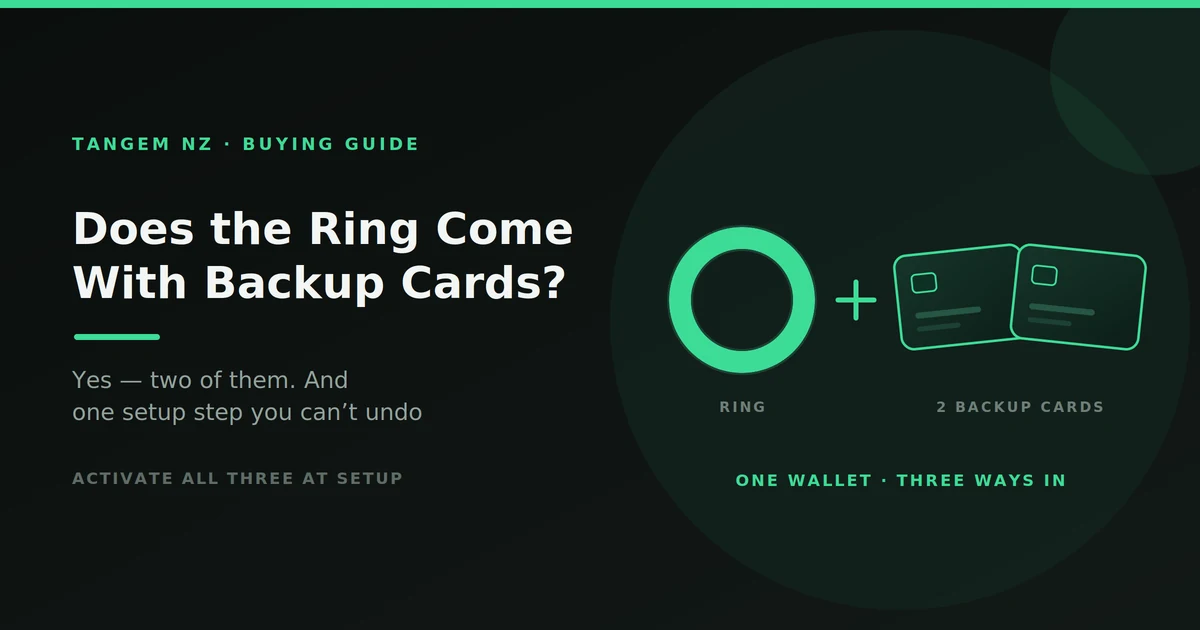
Fair enough. So: does the Tangem Ring come with backup cards? Yes two of them, in the box, using the same chip and the same recovery model as the ring itself. That’s the short answer. The part worth reading is what you have to do during setup, because there’s one step you can’t undo afterwards.
The short answer: two cards are included
The Tangem Ring ships with two Tangem cards. They use the same EAL6+ secure element and the same seedless design, and each one gives full access to the same wallet. Tangem includes them precisely because a wearable device is the easiest hardware wallet to lose.
One clarification before we go further: you get backup cards, not a backup ring.
What’s in the box
- The Tangem Ring, in the size you ordered
- Two Tangem cards
- A quick start guide
The packaging typically shows the product data and ring size on the outside, which is worth checking before you open it.
Why cards instead of a second ring
Three practical reasons.
Sizing. A spare ring would have to fit the same finger, which means a second sizing decision and a second thing to get wrong.
Cost. The ring is the expensive part of the set. Two rings would roughly double the price for no additional security.
Storage logic. A card in a safe at a relative’s house is better cold storage than a second ring you’d never wear. The backup is supposed to live somewhere you aren’t.
How the ring and cards work together
All three devices are initialised during setup as a single wallet. Each holds an identical copy of the private key, and each gives full access to every address.
They’re interchangeable, not hierarchical. There’s no “main” device.
One wallet, three ways in
Tapping the ring to your phone and tapping a card to your phone do exactly the same thing. Same balance, same transaction history, same everything.
That’s why losing the ring isn’t a crisis it’s an inconvenience. The wallet doesn’t live on the ring. The ring is one of three keys to it.
The access code
During setup you set an access code a minimum of six characters, with no upper limit. It protects the set against someone who physically finds a device.
So a ring lost on a beach isn’t an open door. Someone would need the ring and the code. That said, if a device is genuinely in someone else’s hands rather than simply missing, moving your funds to a new wallet is the clean response.
The setup step you can’t undo
This is the most important paragraph on this page.
New cards cannot be added after setup is finalised. You decide the size of your set before you begin, and every device you intend to use has to be activated during that initial setup.
What that means in practice:
- Activate the ring and both cards during setup. All three. In one sitting.
- A card you left in the box unactivated is not a backup. It’s a blank card.
- If you skip one and realise later, the remedy is creating a new wallet with the full set and transferring your funds across.
That’s not a difficult process, but it’s an avoidable one. Set aside fifteen uninterrupted minutes and do it properly the first time.
What happens if you lose the ring
The sequence, rather than reassurance:
- Your funds are untouched. They were never on the ring. The ring is one way of authorising access to them.
- Tap a backup card to your phone in the Tangem app. The wallet, balance and full history appear immediately.
- Decide what to do next, which depends on how it was lost.
Lost or stolen?
Misplaced off in the garden, down a drain, somewhere in the house and you carry on using the wallet with your cards. The access code stands between a finder and your funds.
Stolen deliberately taken, particularly if someone may have watched you enter your code — and the safer response is creating a new wallet and moving the funds. It costs you fifteen minutes and removes the question entirely.
Replacing the ring
Here’s the detail almost nobody knows before they need it.
Because devices can’t be added to a wallet after setup is finalised, a replacement ring generally can’t simply join your existing wallet. The practical path is setting up a new wallet with the new ring and your cards, then transferring funds across.
Ring set or cards alone?
| Ring set (ring + 2 cards) | 3-card set | Both | |
|---|---|---|---|
| What you carry daily | The ring, on your hand | Nothing — cards stay stored | Ring daily, cards stored |
| How you sign | Tap your hand to your phone | Retrieve a card, then tap | Either |
| Backup devices | Two cards | Two spare cards | Plenty |
| Where it lives | On you | In a safe or drawer | Both |
| Best for | Frequent transactions | Long-term holding | Active users with reserves |
| Relative price | Highest | Lowest | Highest |
[PLACEHOLDER: insert current NZD pricing for the ring set and card sets.]
Two honest points about that comparison.
The ring doesn’t buy extra security. The chip, the secure element, the seedless model and the app are identical across both form factors. What you’re paying for is conveniencea wallet that’s already on your hand when you want to sign something.
If you transact rarely, cards are better value. Cold-storage discipline generally favours a wallet that lives somewhere it can’t be lost or damaged in daily life. The ring deliberately inverts that, which suits someone signing transactions weekly and suits a long-term holder less well.
Where to keep the cards in New Zealand
The two included cards only function as backups if they’re somewhere the ring isn’t and somewhere they aren’t together.
A realistic split
- The ring on your hand
- One card at home, somewhere not obvious and not labelled
- One card elsewhere a trusted family member, a workplace safe, a safe deposit box
Two cards in the same drawer is one backup with extra steps.
The local hazards worth planning around
- Earthquakes. In Wellington or Canterbury, “at home” can become a location you can’t reach for a while.
- Flooding. Cards are tougher than paper, but a flooded garage is still the wrong place for your only backup.
- Moving and flatting. This is the one that actually loses devices. Every move is a chance for a card-sized object to vanish.
Test it before you trust it
In the week you set up, put a small amount in the wallet, then tap a backup card rather than the ring and confirm the wallet appears correctly. Then store that card in its separate location.
A backup you’ve never tested is an assumption.
Daily wear: what the ring actually handles
The ring is made of zirconia ceramic scratch-resistant, hard-wearing, and rated IP68 for dust and water. It operates between roughly −25°C and 50°C, and it has no battery at all, since it uses passive NFC. There’s nothing to charge, ever.
For New Zealand daily life that covers the realistic list: dishes, showers, rain, the beach, the gym, gardening, a swim.
The honest limits:
- Ceramic is hard but not indestructible. It resists scratches better than metal and can chip under a sharp, hard impact.
- No rating covers loss. IP68 protects against water. It doesn’t help when the ring comes off in the sea.
- No screen. You verify transaction details on your phone, not on the ring.
Sizing matters more than you’d expect
A ring that’s slightly loose comes off in cold water. A ring that’s slightly tight stays in a drawer.
Tangem publishes a sizing guide and lists sizes from 8 to 13 US. Measure properly before ordering rather than guessing from another ring you own different profiles fit differently.
Buying in New Zealand
Three things worth getting right.
Buy sealed, from an authorised seller. Never a marketplace listing or a used device. A pre-configured wallet means someone else may already hold access, and that risk applies to every hardware wallet brand equally.
Buy locally where you can. GST and delivery are handled, the wait is days rather than weeks, and the Consumer Guarantees Act gives you rights against a New Zealand retailer rather than an overseas seller.
Sort the sizing question before you order. Ask what happens if it doesn’t fit that’s a five-minute conversation before purchase and a frustrating one afterwards.
You can see the range and sizing guidance at Tangem NZ.
FAQs
Does the Tangem Ring come with backup cards?
Yes, two Tangem cards are included in the box. They use the same secure element and the same seedless model, and each gives full access to the same wallet.
How many devices come in the set?
Three in total: the ring and two cards. All three should be activated during initial setup so that each one works as a backup.
What if I lose the ring?
Tap one of your cards to your phone and the wallet appears with your balance and history intact. If the ring was stolen rather than misplaced, consider moving your funds to a new wallet.
Can I add more cards later?
No. Devices are linked during initial setup, and new cards can’t be added afterwards. Decide the set size before you begin otherwise the only route is a new wallet and a transfer.
Is the Tangem Ring waterproof?
It’s rated IP68 for dust and water, with an operating range of about −25°C to 50°C. Showers, rain and swimming are fine. Losing it in the sea is a different problem.
Should I buy the ring or just the cards?
Cards if you’re holding long-term and transact rarely they’re cheaper and suit cold-storage discipline. The ring if you sign transactions often and want the wallet already on your hand. The security is identical either way.
Does the ring need charging?
No. It uses passive NFC and has no battery, so there’s nothing to charge or replace.
The bottom line
Yes, two cards come in the box, and they’re the reason a lost ring is an inconvenience rather than a disaster.
The three things that matter: activate every device during setup, because you can’t add them later; store the two cards in genuinely separate places, not the same drawer; and test a card before there’s real money riding on it.
Do those and the ring becomes what it’s meant to be the convenient way into a wallet that’s properly backed up somewhere else.