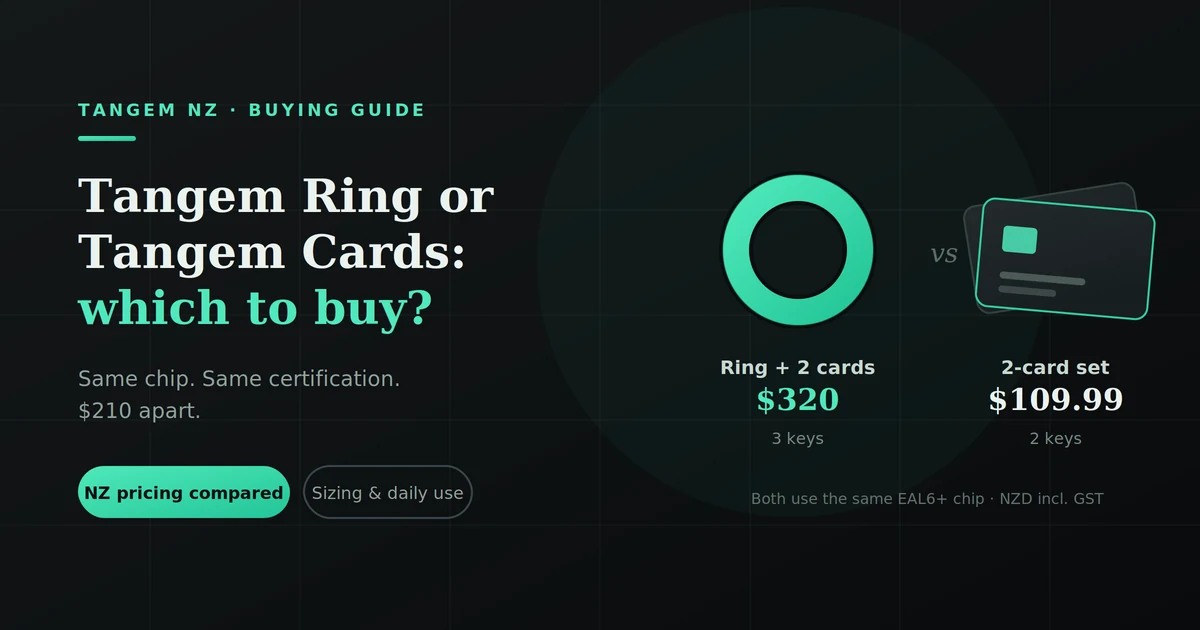
Two products sit in your cart. A card set at $109.99, or the Ring at $320. Both say Tangem, both do cold storage, and nothing on either page makes it obvious what the extra $210 actually buys you.
Tangem Ring or Tangem Cards
Here’s the first thing to clear up, because it changes the whole question: the Tangem Ring or Tangem Cards decision isn’t either/or. The Ring ships as a ring plus two cards. You’re not choosing between form factors so much as choosing whether one of your three keys goes on your finger. What follows is what genuinely differs, what doesn’t, and which suits how you actually live.
The short answer: same wallet, different way to reach it
The chip, the security certification and the way your private key is created are identical in both. What differs is the physical object you tap against your phone, what it costs, and whether wearing it suits your hands, your job and your habits.
Anyone telling you one is cryptographically safer than the other is selling, not explaining.
First, clear up what you are actually buying
A Tangem wallet isn’t one device. It’s one set of matching keys spread across two or three physical devices, each granting identical access to the same wallet. Think of them as copies of the same house key, not as separate houses.
That design is the whole point. There’s no seed phrase to write down because the backup is the other devices in the set.
How a set actually works
Tap any device in the set to your phone and you’re in the same wallet, seeing the same balances. Lose one and the others still work. This is why Tangem can sell a seedless wallet at all: the redundancy lives in hardware rather than in twelve words on a piece of paper.
If the Ring itself is new to you, our guide to what the Tangem Ring is and how it works covers the basics before you compare.
What’s available in New Zealand right now
| Product | Devices in the set | Price (NZD, incl. GST) |
|---|---|---|
| Tangem Wallet 2 Card Set | 2 cards | $109.99 |
| Tangem Wallet 3 Card Set | 3 cards | $139.99 |
| Tangem Ring | 1 ring + 2 cards | $320.00 |
| Family Pack | Two separate wallets | $279.60 |
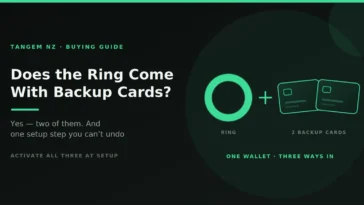
Note the Ring set gives you three keys, same as the 3-card set. The difference is that one of them is wearable. If you’re unsure what comes in the box, we’ve answered that separately: does the Tangem Ring come with backup cards?
Security: identical, and here’s why that matters
Both use the same EAL6+ certified chip, developed with Samsung Semiconductors the security grade used in biometric passports. Both generate a random private key on the chip itself, offline, where it cannot be exported or copied. Both are protected by an access code against brute-force attempts.
The independent reviews apply equally to both. Tangem’s hardware and software have been independently audited three times: by Kudelski Security in 2018, by Riscure in 2023, and by Cure53 in 2026 covering the mobile app. None of those audits found backdoors or exploitable vulnerabilities. The firmware cannot be updated after manufacture, the app is open source and rebuildable from GitHub, and Tangem’s servers aren’t involved in your transactions either way. BlockchainReporter
One thing that does matter regardless of form factor: buy only from official channels. The app cryptographically verifies each device’s authenticity on first scan, specifically to guard against counterfeit hardware sold through third-party sellers. BlockchainReporter
So when you’re comparing Ring against cards, take security off the list. It’s not a variable here. What remains is entirely practical and practical is where people actually get this decision wrong.
Where they genuinely differ
The real differences are cost, how you carry the thing, how visible it is, and whether it has to fit your body. That last one is the risk nobody thinks about until the parcel arrives.
| Tangem Ring (with 2 cards) | Tangem Card Set | |
|---|---|---|
| Price (NZD incl. GST) | $320.00 | $109.99 (2 cards) / $139.99 (3 cards) |
| Keys in the set | 3 | 2 or 3 |
| How you carry it | Worn on your finger | Wallet, drawer or safe |
| Discretion in public | Visible, though it reads as jewellery | Looks like an ordinary bank card |
| Tapping your phone | Present the back of your finger | Flat card against the phone |
| Sizing risk | Real must fit, can’t be resized | None |
| Suitability at work | Restricted around machinery on many sites | No restriction |
| Exposure to knocks and water | Constant daily wear | Only when you use it |
| Best for | Frequent access, everyday carry | Long-term holding, gifts, tight budgets |
The case for the Ring
The Ring’s advantage is simple and genuine: it’s already on you. No wallet to find, no drawer to open, no “where did I put it” moment before authorising a transaction. Access becomes a gesture rather than a search.
Always with you
If you move crypto regularly swaps, staking, sending the difference between “tap the thing on my hand” and “go get the card” compounds. It’s a small friction removed many times over, which is exactly the kind of thing that changes whether you bother using self-custody properly.
It’s also useful when travelling. Nothing extra in your bag, nothing to leave in a hotel room, nothing to lose in transit.
It reads as jewellery
To anyone glancing at your hand, it’s a ring. No screen, no logo shouting a brand, no cable. That’s a meaningful kind of discretion though as we’ll come to, it’s a different kind than the card offers.
No battery, built to last
Same monolithic construction as the cards: no seams, no ports, nothing to charge, no moving parts to fail. Tangem lists the same dust and water protection rating for both the Ring and the Card. Tangem rates the hardware for a 25+ year service life with a matching warranty. Tangem
For something worn daily, that durability isn’t a marketing line. It’s the reason a wearable hardware wallet is viable at all.
The honest note on price
At $320 you’re paying roughly $180 more than the 3-card set for the same three keys, one of which happens to be wearable. If you’ll use it daily, that’s a fair price for removing friction. If you’ll transact twice a year, you’re paying for convenience you won’t experience.
The case for the Card
Cards are cheaper, they don’t have to fit anyone, and they disappear into a wallet or a safe without drawing a second look. For a large share of buyers, they’re simply the more sensible tool.
It looks like a bank card
This is a real security property. A Tangem card in your wallet is indistinguishable from a loyalty card at a glance. It carries no signal about what you own, or that you hold crypto at all.
A ring on your finger is discreet in the sense that it looks like jewellery, but it’s still visible and to anyone who recognises it, it says something specific. If you’ve been public about holding crypto, or you travel through places where that’s worth not advertising, the card is the quieter choice.
Nothing to size
You can order a card set for yourself or as a gift and know it will work. No measuring, no guessing between sizes, no exchange if you get it wrong. That alone makes cards the default recommendation for gifts.
Better for storage you rarely touch
If you’re a long-term holder who buys and then leaves it alone, a card in a safe is arguably the better instrument. Nothing to wear out, nothing exposed to daily knocks, and no reason to pay for instant access you don’t need.
Cold-storage best practice favours keeping a hardware wallet in a safe or lockbox and taking it out only for transactions. The Ring deliberately inverts that model it’s meant to be worn rather than stored, trading some of that traditional posture for convenience. Neither approach is wrong. They suit different people. Tangem
Practical questions people don’t ask until after they order
Three things decide whether you’ll be happy with a ring six months in: whether it fits, whether your work allows it, and whether you’re comfortable wearing something that identifies you as a crypto holder.
Ring sizing is the real risk
A Tangem Ring can’t be resized. There’s no jeweller who can adjust it, because the chip and antenna run through the band. The Ring is available in US sizes 6 to 13. Tangem
Measure at a normal temperature rather than after exercise or on a cold morning, decide which finger and hand before you measure, and check the exchange policy before ordering rather than after. We’ve covered the method properly in how to choose your Tangem Ring size read it before you order, not after.
Tapping with a ring versus a card
Phone NFC antennas sit in different places depending on the model. With a card, you slide it around the back of the phone until it reads. With a ring, you present the back of your finger, which takes a little practice and then becomes automatic.
Neither is difficult. It’s just a different motion, and the first few taps may take a moment to find the sweet spot.
Work, sport and safety
Worth being direct about this, because most Tangem comparisons skip it entirely.
Many New Zealand worksites prohibit rings around rotating machinery, and for good reason ring-related hand injuries are a recognised hazard in trades, engineering and farming. If you’re a sparky, a mechanic, a builder or working with stock and machinery, a ring you have to remove every shift isn’t a convenience. It’s a thing you’ll lose in a ute door pocket.
The same logic applies to the gym, rock climbing, and anywhere you’d normally take a ring off. And if you take it off at the beach, you’ve now got a hardware wallet sitting in a bag on the sand.
None of this rules out the Ring. It just means the “always with you” advantage only holds if your day actually allows it to be.
What happens if you lose the whole set
This is the question worth facing before you buy, not after. If you lose every device in a wallet set and haven’t enabled a seed phrase, the funds are permanently unrecoverable. No entity, including Tangem, can restore them. Tangem
That isn’t a flaw in the product. It’s what self-custody means: counterparty risk disappears, and key management becomes entirely your responsibility.
Two things follow from it:
- Separate your devices physically. A ring on your hand and two cards in the same bag is one theft, one fire, one lost bag away from total loss. Different rooms at minimum, different buildings ideally.
- Know that the seed phrase option exists. A 12 or 24 word seed phrase is available during setup for users who want it, though most people never enable it. If the seedless model makes you uneasy, that’s the lever but a written seed phrase reintroduces exactly the vulnerability the design removes. Choose one model deliberately rather than half of each. Kristian Larsen
Storing your backups, whichever you choose
The devices you’re not carrying are your recovery method. Treat them as such and this decision becomes much lower-stakes.
- Verify every device in the set opens the wallet before you fund it. An untested backup isn’t a backup.
- Store backups separately from the one you carry.
- Set an access code you can recall without a note stored on your phone.
- Treat the set as one wallet. These aren’t spares to give away or sell. Each one is full access.
- Remember the margin. A three-key set including the Ring set tolerates losing one device. A 2-card set is less forgiving if you also forget your access code.
Which should you buy?
Buy the Ring if you move crypto often enough that convenience matters, you know your ring size with confidence, your work and hobbies don’t require taking rings off constantly, and you’re comfortable with something visible on your hand. The set gives you three keys, so backup isn’t a compromise.
Buy a card set if you’re buying a gift, you’re unsure about sizing, you work around machinery, you’re watching the budget, or you’re a long-term holder who accesses the wallet rarely. There’s nothing second-rate about this choice it’s the right tool for most people.
Choose 3 cards over 2 if you want the extra recovery margin. For $30 more, losing one card stops being a problem you have to solve immediately. It’s the easiest upgrade decision on this page.
FAQs
Is the Tangem Ring more secure than the card?
No. Both use the same EAL6+ certified chip, generate the private key offline on the device, and are protected by the same access code system. The difference is entirely physical how you carry it and what it costs
Does the Tangem Ring come with cards?
Yes. The Ring is sold in New Zealand as a set with the ring plus two backup cards for $320.00 NZD including GST. All three devices open the same wallet.
What happens if I lose my Tangem Ring?
Nothing is lost, provided your backup cards are stored safely and separately. Tap either card to your phone to access the wallet as normal, then follow Tangem’s process to remove the missing device’s access.
What if I lose all three devices?
Without a seed phrase enabled, the funds cannot be recovered by anyone, including Tangem. This is why storing your backups in separate locations matters more than which form factor you pick.
Can I resize a Tangem Ring?
No. The chip and antenna are built into the band, so a jeweller can’t adjust it. Measure carefully before ordering and check the exchange policy first.
How much is the Tangem Ring in NZ?
$320.00 NZD including GST for the ring with two cards, compared with $109.99 for a 2-card set and $139.99 for a 3-card set.
Can I use a ring and cards on the same wallet?
Yes, that’s how the Ring set works. Up to three cards or rings can share the same private key, and any of them can be tapped to manage the wallet. Tangem
Still deciding?
If you’re leaning Ring, measure your finger first it’s the one part of this decision you can’t undo. If you’re leaning cards, take the 3-card set over the 2-card for $30.
Either way, both live in the same place: Tangem NZ, shipped locally with GST included. Questions about sizing or which set suits your setup, send them through and we’ll answer straight.