A crypto wallet you wear on your finger. People react to that in one of two ways clever, or ridiculous and there isn’t much middle ground.
So here’s the plain version. The Tangem Ring is a hardware wallet built into a ceramic ring. It holds a private key on a secure chip, signs transactions when you tap it to your phone, and has no battery, no screen and nothing to charge. Whether that’s clever or ridiculous depends entirely on how you use crypto, and this article should settle it either way.
The short answer: a hardware wallet you wear
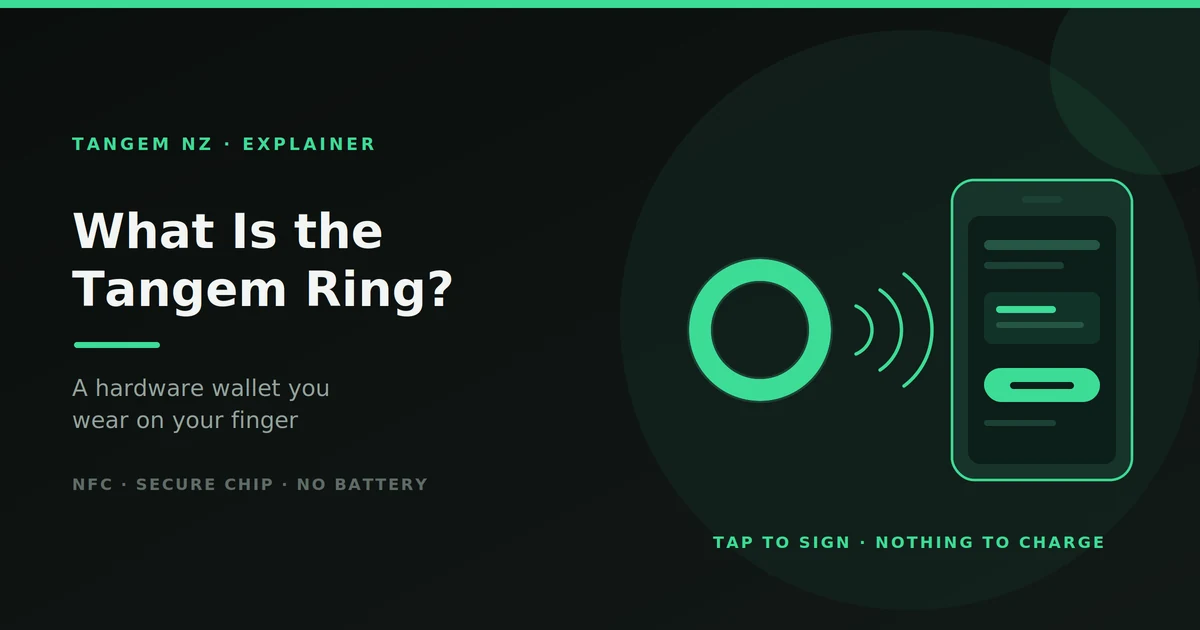
The Ring stores a private key inside a secure element and signs transactions over NFC when tapped against your phone. There’s no cable, no charging and no screen. It’s the same security model as Tangem’s cards the difference is what you carry, not how it protects you.
That last point matters more than anything else in this article, and we’ll come back to it.
How it actually works
Four things happen, in this order.
The key is generated inside the ring
During setup, the private key is created on the chip inside the ring. It isn’t sent to Tangem, it isn’t stored on your phone, and it isn’t printed anywhere which is why there’s no recovery phrase to write down in the default setup.
Nothing leaves the chip. Not during setup, not during a transaction, not ever.
Tap to sign
When you want to send crypto, you build the transaction in the Tangem app on your phone. Then you tap the ring to the back of the phone.
The ring receives the transaction, signs it internally using the key it holds, and passes the signed result back. Your phone handles the network side but never sees the key itself. An attacker with full control of your phone still can’t move your funds without the ring physically present.
No battery, ever
The Ring uses passive NFC, drawing the small amount of power it needs from your phone’s field during the tap.
That’s why there’s nothing to charge, no battery to degrade after a few years, and no reason it can’t be worn continuously. It’s also why it has no screen a display needs power the ring doesn’t have.
The access code
During setup you create an access code of at least six characters. It protects the wallet against someone who physically finds a device.
So a ring lost at the beach isn’t an open door. Someone would need the ring and the code.
What’s in the box
- The Ring, in the size you ordered
- Two Tangem cards
- A quick start guide
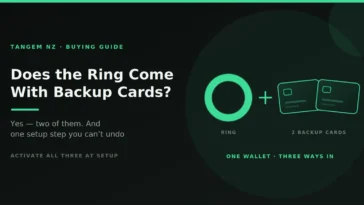
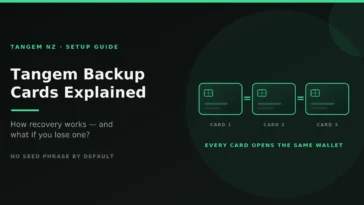
The cards aren’t an accessory they’re your backup. A ring lives on your hand, which makes it the easiest hardware wallet in the world to lose, so Tangem includes two cards that access the same wallet. Lose the ring, tap a card, carry on.
They’re cards rather than a spare ring for practical reasons: a second ring would need to fit the same finger, and a card in a drawer at a relative’s house is better cold storage than a second ring you’d never wear.
There’s one setup rule worth knowing before you start: all three devices have to be activated during initial setup, because devices can’t be added afterwards. We’ve covered the backup and recovery side in detail separately worth reading before you set yours up.
What it’s made of and what it survives
The Ring is zirconia ceramic scratch-resistant, hard-wearing, and rated IP68 for dust and water. It operates between roughly −25°C and 50°C.
For everyday New Zealand life, that covers the realistic list:
- Dishes, showers, rain
- The gym, gardening, DIY
- A swim at the beach or in a pool
- Summer heat and a Central Otago winter
The honest limits:
- Ceramic is hard but not indestructible. It resists scratches better than metal and can chip under a sharp, hard impact against tile or concrete.
- IP68 covers water, not loss. No rating helps when a ring comes off in the surf.
- No screen, which has consequences covered below.
Sizing: the thing people get wrong
A ring that’s slightly loose comes off in cold water. One that’s slightly tight lives in a drawer.
Sizes are listed from 8 to 13 US, and Tangem publishes a sizing guide. Measure properly rather than guessing from another ring you own different profiles and widths fit differently, and a wide ceramic band sits differently from a thin metal one.
Ring or cards: what you’re actually paying for
| Tangem Ring set | Tangem card set | |
|---|---|---|
| What you carry daily | The ring, on your hand | Nothing cards stay stored |
| How you sign | Tap your hand to your phone | Retrieve a card, then tap |
| Backup included | Two cards | Spare cards in the set |
| Chip and security model | Identical | Identical |
| Water rating | IP68 | Cards are water-resistant, not rated the same |
| If you lose it | Tap a backup card | Tap another card |
| Relative price | Roughly triple | Lowest |
Here’s the part a retailer isn’t supposed to say plainly, so I’ll say it plainly.
The security is identical. Same secure element, same seedless model, same app, same supported assets. The Ring is not a more secure wallet than the cards, and anyone implying otherwise is selling you something.
What the extra money buys is convenience a wallet that’s already on your hand when you want to sign something, instead of one you have to go and find. That’s a real benefit if you transact weekly. It’s worth very little if you buy crypto twice a year and leave it alone.
Who it’s actually for
A good fit if you:
- Transact regularly, and the friction of finding a card annoys you
- Know yourself well enough to admit a card would end up in a drawer and stay there
- Travel, and like having access without carrying anything identifiable
- Value that it reads as jewellery rather than as a crypto device
That last point is worth naming without dramatising it. A ring doesn’t look like a hardware wallet. For some people that’s a meaningful consideration, and it’s a legitimate reason to prefer this form factor.
A poor fit if you:
- Hold long-term with a substantial balance and rarely move anything cold storage discipline favours a wallet that can’t be lost in daily life, and the Ring deliberately inverts that
- Aren’t confident about ring sizing
- Want to verify transaction details on the device itself rather than your phone
What it doesn’t do
The limits, stated clearly, because you’ll find them eventually anyway.
No screen. You verify transaction details on your phone, not on the ring. Devices with their own display let you confirm an address on hardware the phone can’t tamper with that’s a genuine advantage those devices have, and the Ring doesn’t have it.
No firmware updates. The chip is fixed at manufacture. Tangem’s argument is that unpatchable firmware can’t be maliciously altered either; the flip side is that if a vulnerability were ever found, the answer would be new hardware rather than a patch.
It isn’t a payment ring. You can’t tap it at a checkout terminal. It talks to the Tangem app, not to point-of-sale systems.
It doesn’t hold your crypto. Nothing does, in the way people imagine. Your coins exist on the blockchain; the Ring holds the key that authorises moving them. That’s why losing the ring doesn’t lose your funds and why losing every device in the set does.
Setting it up
The short version, since the detail belongs in the backup guide:
- Activate all three devices in one sitting the ring and both cards. New devices can’t be added after setup is finalised.
- Set your access code, at least six characters, and don’t make it one you’ll forget.
- Test recovery by tapping a backup card rather than the ring, before there’s any real balance on the wallet.
- Store the cards separately one at home, one somewhere else. Two cards in the same drawer is one backup with extra steps.
Buying one in New Zealand
Three things worth getting right.
Buy sealed, from an authorised seller. Never a marketplace listing, never used. A pre-configured device means someone else may already hold access a risk that applies to every hardware wallet brand equally.
Buy locally. GST and delivery are handled, the wait is days rather than weeks, and the Consumer Guarantees Act gives you rights against a New Zealand retailer rather than an offshore seller.
Sort the sizing before you order. Ask what happens if it doesn’t fit. Five minutes before purchase saves a frustrating conversation after.
You can see the range and sizing guidance at Tangem NZ.
[PLACEHOLDER: current NZD pricing for the ring set and card sets, refreshed at publish.]
FAQs
What is the Tangem Ring?
A hardware wallet built into a ceramic ring. It holds a private key on a secure chip and signs crypto transactions when you tap it to your phone over NFC. It ships with two backup cards.
Does the Tangem Ring need charging?
No. It uses passive NFC and has no battery, drawing the power it needs from your phone during the tap. There’s nothing to charge and no battery to replace.
Is the Tangem Ring waterproof?
It’s rated IP68 for dust and water, with an operating range of about −25°C to 50°C. Showers, rain and swimming are fine losing it in the sea is a different problem.
Can I pay with it in shops?
No. It isn’t a contactless payment device. It communicates with the Tangem app to sign crypto transactions, not with checkout terminals.
What happens if I lose the ring?
Tap one of the two included cards to your phone and your wallet appears with your balance and history intact. If it was stolen rather than misplaced, move your funds to a new wallet.
Is a ring less secure than a card?
No, the chip, the security model and the app are the same. The practical difference is that a worn device is easier to lose and harder to store in a safe, which is why the backup cards matter.
Which cryptocurrencies does it support?
The same assets as Tangem’s other devices, across many major blockchains. Check the current supported list before buying if you hold something unusual.
The bottom line
The Tangem Ring is a hardware wallet in an unusual shape. The key lives on a chip inside it, it signs by tapping your phone, and it never needs charging.
What it isn’t is a more secure wallet than the cards. Same chip, same model you are paying for convenience, and whether that’s worth it comes down to one question: do you actually transact often enough to notice the friction of fetching a card?