Every other hardware wallet hands you 24 words and tells you to guard them with your life. Yours came with a second card and a five-minute setup, and somewhere in the back of your mind you’re wondering whether it’s really that simple.
Tangem Backup Cards
It is and understanding how Tangem wallet backup cards work is worth ten minutes, because there’s one decision made during setup that’s difficult to reverse later, and one failure mode that nobody can rescue you from.
The short answer: your backup card is the wallet
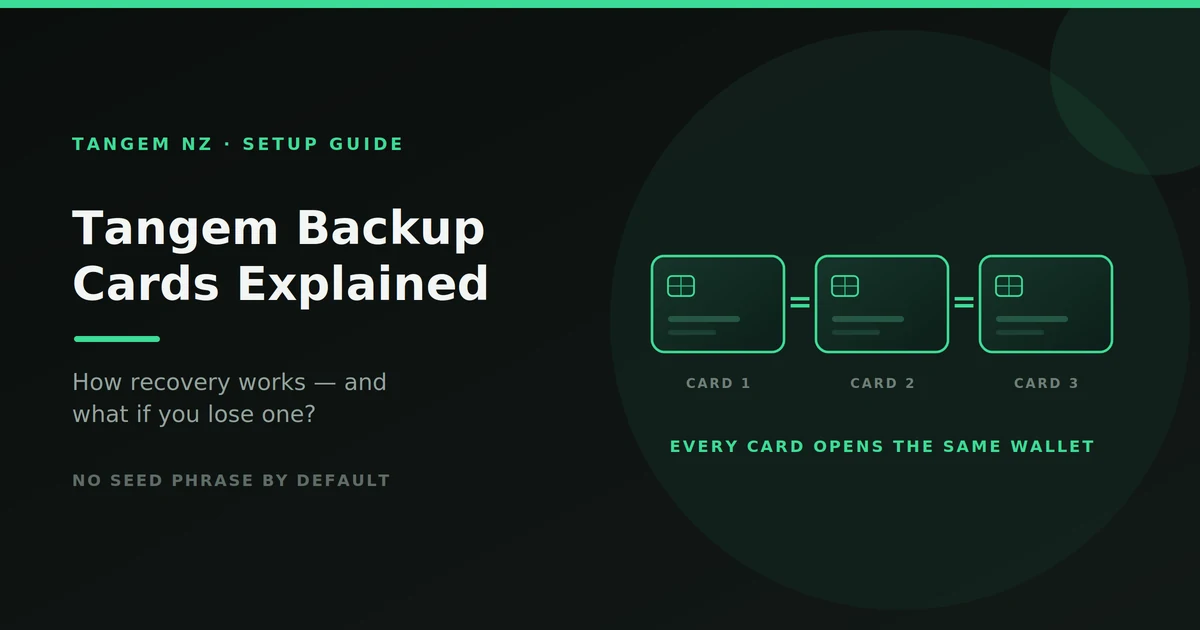
Each card in a Tangem set holds identical access to the same wallet. Recovery means tapping a different card to your phone instead of typing out a recovery phrase. The cards are interchangeable rather than hierarchical there’s no “main” card and no lesser spare.
That’s the whole model. Everything below is detail, consequences, and the one choice you make at setup.
How the cards hold your wallet
When you set up a Tangem wallet, the private key is generated inside the card’s secure chip and never leaves it. It isn’t transmitted to Tangem, it isn’t stored on your phone, and it isn’t printed anywhere which is precisely why there’s no phrase to write down.
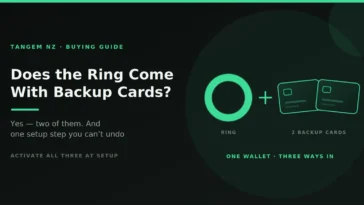
Backup happens during that same setup. You tap a second card, and if you have a three-card set, a third. Each one is initialised to share the same wallet.
Interchangeable, not hierarchical
This is the part people most often misunderstand.
Card 2 isn’t a copy of Card 1 in the sense that a photocopy is a copy of a document. Each card independently controls every address in the wallet. Tap any one of them and you have full access same balance, same history, same everything.
So “which card is the main one?” has no answer. There isn’t one. That’s a feature: it means losing any particular card is not a special problem.
What the access code does
During setup you create an access code, which protects the cards against brute-force attempts. If someone finds your card in a car park, the card alone doesn’t give them your crypto.
Two things worth knowing:
- You can set a unique access code for each card if you want them separated.
- On current wallets you can turn off access code recovery via a backup card, which tightens security at the cost of convenience if you forget the code.
Choose deliberately. A code you can’t remember is its own kind of loss.
What actually happens when you lose a card
Nothing dramatic, if you’ve set up properly. The sequence:
- Get the Tangem app on your phone, if it isn’t already installed a new phone is fine.
- Tap your backup card to the phone.
- That’s it. Your wallet, balance and full transaction history appear immediately.
No recovery sheet to find, no 24 words to type in the correct order, no anxiety about whether you transcribed word 17 properly two years ago.
Lost or stolen? The distinction matters
Misplaced down the back of a couch, left at a relative’s house and you simply carry on with your other cards. If it turns up later, it still works.
Stolen deliberately taken and the safer response is to move your funds to a new Tangem wallet. The access code stands between a thief and your crypto, but if the card is genuinely in someone else’s hands, removing the funds from that wallet entirely is the clean answer.
If you’re down to one card
Stop and think about this one. A single remaining card means you’re running with no backup at all exactly the position the card set was designed to prevent.
Two sensible responses: treat that card very carefully, or move your funds to a new wallet created with a fresh set. The second is the safer choice if the balance matters to you.
What happens if you lose all of them
Here’s the part that deserves plain language rather than reassurance.
If every card in your set is gone and you didn’t set up a seed phrase, the funds cannot be recovered. Not by you. Not by Tangem. Not by anyone. The keys were generated on-chip and never transmitted, so there is no copy anywhere for a support team to retrieve.
That isn’t a Tangem-specific limitation it’s how cryptographic self-custody works. Any wallet where the company can restore your funds is a wallet where the company controls your funds.
Two practical notes before you conclude the worst:
Search properly first. Tangem cards are the size of a bank card and disappear into bags, jacket pockets, desk drawers, filing trays and safes. People find them.
If you did set up a seed phrase, that phrase is your way back which brings us to the decision you make at setup.
The setup choice: seedless or seed phrase
Newer Tangem wallets let you choose. The default is the seedless card model. The alternative is generating a standard BIP39 seed phrase, or importing one from a wallet you already have.
| Seedless card set | Card set + generated seed phrase | Imported wallet | |
|---|---|---|---|
| What the backup is | Your other cards | Cards and 12 or 24 written words | Your existing phrase |
| How you recover | Tap another card | Tap a card, or restore the phrase anywhere | Either |
| Works on other brands | No | Yes, any BIP39-compatible wallet | Yes |
| Main risk | Losing every card | The written phrase being lost or found | Derivation path mismatch |
| Suits | People who’d mishandle a phrase | People who want an exit route | People consolidating wallets |
The case for seedless
The reason Tangem built it this way: mishandled recovery phrases are one of the largest causes of permanently lost crypto. Estimates put the amount of Bitcoin that is permanently inaccessible at up to 3.7 million coins roughly a fifth of the total supply with most of it lost to misplaced keys and phrases rather than to hacking.
Seedless removes that entire category of risk. There’s no paper to lose, nothing to photograph accidentally, nothing for a flatmate to find, and nothing to type into a convincing fake website.
The case for taking the seed phrase option
The honest counter-argument, and it’s a real one.
A BIP39 phrase is a standard. Generate one and your wallet can be restored on a Ledger, a Trezor, a software wallet anything BIP39-compatible. That’s an exit hatch: you’re not dependent on one manufacturer continuing to exist, continuing to sell cards, or continuing to support your model.
The cost is exactly what you were avoiding. You now have a piece of paper that must survive a decade, and if someone finds it, they have your crypto without needing any of your cards.
If you take this option, the phrase is shown once. Write it on paper, never photograph it, never type it into anything, and store it separately from your cards.
Importing a wallet you already have
You can import an existing wallet using a phrase of 12, 15, 18, 21 or 24 words. One technical caveat that trips people up: the import supports the default BIP-44 derivation path. If your original wallet used a non-standard path, the addresses won’t match and your balance will appear to be missing even though the import “worked.”
If that happens, the crypto isn’t gone it’s at addresses on a different path. Check the source wallet’s documentation before assuming the worst.
Two cards or three?
Two gives you a backup. Three gives you a backup and a spare.
That sounds like an upsell, so here’s the reasoning: the realistic threat to your cards isn’t a burglar. It’s ordinary attrition a house move, a flood, a relative tidying a drawer, a bag left on a bus. Those events tend to take out one location at a time, and a third card in a third location is what keeps a bad day from becoming a permanent loss.
If you’re securing an amount that would genuinely hurt to lose, three.
Where to keep your cards in New Zealand
Storing all your cards in the same place defeats the entire point of having more than one.
Separate locations, realistically
The practical setup for most people: one card at home, one with a trusted family member, and — with a three-card set one somewhere else again, such as a workplace safe.
Two drawers in the same house is not two locations. A fire, a flood or a burglary reaches both.
The NZ-specific hazards
Worth thinking about honestly:
- Earthquakes. If you’re in Wellington or Canterbury, “in the house” is a location that can become inaccessible.
- Flooding. Cards are more water-resistant than paper, but a flooded garage is still a bad place to keep your only backup.
- Moving and flatting. This is the one that actually takes cards. Every move is an opportunity to lose something the size of a bank card, and people in shared housing move often.
Test your recovery before you trust it
Do this the week you set up, not the week you need it.
Put a small amount in the wallet, then tap your backup card rather than your primary one and confirm the wallet appears with the correct balance. Then put the backup card away in its separate location.
A backup you’ve never tested is an assumption, not a backup.
Mistakes that cost people their crypto
- All cards stored together. Three cards in one wallet is one card with extra steps.
- Never activating the backup cards during setup. A card that was never added to the set isn’t a backup it’s a blank card.
- Photographing a generated seed phrase. Photos sync to cloud accounts automatically. If that account is ever breached, so is your wallet.
- Buying cards from a marketplace listing. A pre-configured card means someone else may already hold access. Buy sealed from an authorised seller.
- Assuming support can help. Tangem cannot recover your wallet, by design. Any message claiming otherwise is a scam.
FAQs
What happens if I lose my Tangem card?
Tap one of your other cards to your phone in the Tangem app. Your wallet, balance and transaction history appear immediately. If the card was stolen rather than misplaced, move your funds to a new wallet.
Can Tangem recover my wallet for me?
No. The private key is generated inside the card and never leaves it, so Tangem has no copy to restore. Anyone claiming they can recover it for you is attempting a scam.
Do I need all my cards to access my crypto?
No. Any single card in the set gives full access to the wallet. The extra cards exist so that losing one isn’t a problem.
Can I add a backup card later?
Backup cards are linked during the initial setup of a wallet. If you want a larger set afterwards, the practical route is creating a new wallet with the full set and moving your funds across.
Does Tangem use a seed phrase?
Not by default the key lives on the card. Newer wallets let you optionally generate a BIP39 phrase or import an existing one, which adds cross-brand portability and the responsibility of protecting a written phrase.
Can I move my Tangem wallet to a Ledger or Trezor?
Only if you set it up with a BIP39 seed phrase. A seedless card wallet has no phrase to export, so it stays within the Tangem card set.
What if someone finds my card?
The access code protects against brute-force attempts, so a found card alone shouldn’t give up your funds. If a card is genuinely lost to someone else, move your crypto to a new wallet.
The bottom line
Recovery on a Tangem wallet is tapping a different card, which is a lower-stress design than protecting a phrase for a decade and it removes the failure mode that has cost people more crypto than hacking ever has.
The things that actually matter: activate every card in the set at setup, keep them in genuinely separate places, test the recovery before real money is involved, and decide deliberately whether you want the BIP39 exit hatch or the cleaner seedless model. Both are valid. Neither survives all your cards living in the same drawer.