Most self-custody guides are written about crypto in general. Bitcoin isn’t quite like the rest of it, and the differences matter when you’re moving real money.
There are no token approvals to worry about. Address formats vary in ways that confuse people. Fees move with network conditions rather than sitting fixed. And a transaction can sit unconfirmed for an hour without anything being wrong.
Using a Tangem wallet for Bitcoin is straightforward once you know those four things. Here’s what’s actually different.
Tangem Wallet for Bitcoin
The short answer
Bitcoin self-custody is simpler than holding tokens on other networks there are no smart contract approvals, so the largest attack class in crypto doesn’t apply.
What you do need to understand: which address format you’re using, how fees work, why confirmations take time, and that nothing about a Bitcoin transaction can be reversed.
What’s genuinely different about Bitcoin
Four things, and each one catches beginners.
There are no token approvals
On Ethereum and similar networks, you grant contracts permission to spend your tokens and those permissions persist, which is how drainer attacks work.
Bitcoin has no equivalent. There’s nothing to approve, nothing to revoke, and no contract holding standing permission over your coins.
That removes a whole category of risk. Our guide to protecting your crypto from scams covers approvals in detail and if you hold only Bitcoin, that section largely doesn’t apply to you.
Address formats vary
This is the one that generates the most confusion. You’ll encounter Bitcoin addresses that look quite different from each other:
- Some begin with 1
- Some begin with 3
- Some begin with bc1
They’re all valid Bitcoin addresses using different formats developed over time. The newer bc1 format generally results in lower transaction fees.
What matters practically: most modern wallets and exchanges handle all of them. But some older services don’t support the newest format, so if a withdrawal is rejected as an invalid address, a format mismatch is the likely reason rather than a fault.
Fees move
Bitcoin transaction fees aren’t fixed. They’re set by network demand when the network is busy, fees rise, and when it’s quiet they fall considerably.
Which means the fee you pay to move Bitcoin today may be several times what you’d pay next week. There’s no urgency to move funds during a busy period unless you need to.
Confirmations take time
A Bitcoin transaction is broadcast immediately but needs to be included in a block, and blocks arrive roughly every ten minutes on average.
An unconfirmed transaction sitting for thirty minutes is normal. It isn’t lost, and it isn’t stuck. Most services wait for several confirmations before treating funds as settled, which is why a transfer can take an hour or more to appear as available.
That’s the single most common panic among first-time users, and it’s usually just the network doing what it does.
How a Tangem wallet holds your Bitcoin
Worth understanding, because it’s simpler than people expect.
Your private key is generated inside the card’s chip and never leaves it. The app builds transactions; the card signs them; the signature goes out to the network. What travels between card and phone is a signature, never a secret.
For Bitcoin specifically, that means: there’s no seed phrase anyone can phish out of you, and nothing on your phone is worth stealing. Our explanation of how seedless wallets work covers the mechanism properly.
| Exchange | Tangem wallet | |
|---|---|---|
| Who holds the keys | The exchange | You |
| What you own | A claim on a company | The Bitcoin itself |
| Phishing risk | Account credentials | No phrase to phish |
| If the company fails | You’re a creditor | Unaffected |
| Sending errors | Sometimes recoverable internally | Never reversible |
| Best for | Buying, selling, trading | Holding |
Setting it up for Bitcoin
The sequence matters more than any individual step.
- Set up the wallet before you have anything to move. Tap the first card, then each backup card, so they all hold the same key.
- Set an access code you’ll remember in five years, under stress. Not stored on the phone you tap the card with.
- Verify every card independently. Close the app, open the wallet with card two. Then card three. An untested backup isn’t a backup.
- Decide where the cards will live separate buildings, ideally one somewhere genuinely unrelated.
- Only then send Bitcoin to it.
Our comparison of the 2-card and 3-card sets explains why three devices is worth the small extra cost, including the fact that you can’t add one later.
Moving Bitcoin to it safely
Four rules, and the first one is non-negotiable.
Send a test transaction first
Send the smallest amount the platform allows. Confirm it arrives in your wallet app not just on a block explorer. Then send the rest.
It costs one extra withdrawal fee. Bitcoin transactions cannot be reversed by anyone, ever, so that fee is the cheapest insurance available.
Copy the address from your wallet app
Never from your transaction history, never typed manually. Address poisoning works by seeding a lookalike address into your history so you copy the wrong one later.
Check the first and last six characters after pasting.
Batch your transfers
Withdrawal fees are usually flat. One larger transfer costs less than several small ones so after your test send, move the rest in as few transactions as sensible.
Don’t panic at an unconfirmed transaction
Thirty minutes with no confirmation is normal. Check the transaction ID on a block explorer if you want reassurance; it’ll show as pending.
Our transfer guide walks through the full process.
What can still go wrong
Being straight about it, because Bitcoin removes some risks and not others.
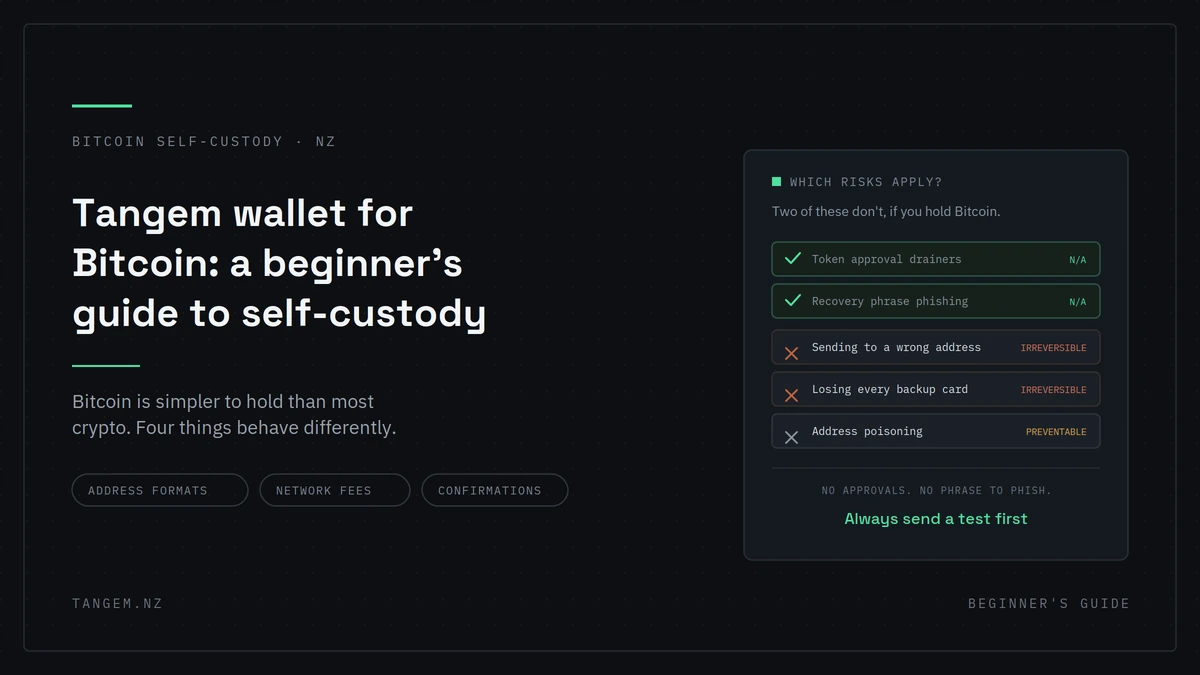
| Risk | Applies to Bitcoin? | Prevention |
|---|---|---|
| Token approval drainers | No — Bitcoin has no approvals | N/A |
| Sending to a wrong address | Yes — and irreversible | Test transaction, copy from app |
| Address poisoning | Yes | Never copy from history |
| Losing all backup cards | Yes | Separate storage, 3-card set |
| Forgetting your access code | Yes | Choose memorable, not clever |
| Phishing for a recovery phrase | No — there isn’t one | N/A |
| Fake support contacting you | Yes | Never discuss holdings publicly |
Two of the seven don’t apply. The rest do, and the two irreversible ones — wrong address and lost backups — are both preventable with habits rather than hardware.
Bitcoin-only, or multiple coins?
Your wallet handles many assets, not just Bitcoin. Worth knowing what that means.
If you hold only Bitcoin, your risk picture is genuinely simpler. No approvals to review, no contract interactions, fewer ways to go wrong.
If you add tokens on other networks later, the approval risk arrives with them and that’s when the security checklist becomes relevant in full.
There’s no need to decide now. Just be aware that adding assets on smart contract networks adds a category of risk that Bitcoin alone doesn’t carry.
Records, from the first transaction
Selling Bitcoin can be a taxable event in New Zealand, and Inland Revenue expects you to be able to show your cost base.
Record from the start: date, amount, NZD value, fees, platform, transaction ID. Moving between wallets you control generally isn’t a disposal selling is.
Two minutes per transaction now versus reconstructing it from bank statements in three years.
[PLACEHOLDER: verify the current IRD position on cryptoassets and link their guidance. Same source needed on the buy-bitcoin and exchange comparison posts — worth resolving all three at once.]
FAQs
Is Bitcoin safer to self-custody than other crypto?
In some respects, yes. Bitcoin has no smart contract approvals, which removes the drainer attack class entirely. The risks that remain wrong addresses, lost backups, phishing apply to any asset.
Why does my Bitcoin address look different from someone else’s?
Bitcoin has several address formats, beginning with 1, 3 or bc1. All are valid; the newer bc1 format generally means lower fees. Some older services don’t support it, which is a common cause of rejected withdrawals.
Why is my transaction taking so long?
Blocks arrive roughly every ten minutes, and most services wait for several confirmations. Thirty minutes to an hour is normal, and an unconfirmed transaction isn’t lost you can check its status on a block explorer.
Why do Bitcoin fees change?
They’re set by network demand rather than fixed. Busy periods cost more; quiet periods considerably less. If you’re not in a hurry, waiting for a quieter period saves money.
Can I reverse a Bitcoin transaction?
No. Nobody can not the network, not us, not an exchange. This is precisely why a small test transaction before a large transfer is worth the extra fee.
Do I need to worry about token approvals with Bitcoin?
No. Bitcoin has no smart contracts granting spending permissions, so there’s nothing to approve or revoke. That changes if you later hold tokens on other networks.
How much Bitcoin should I hold before getting a hardware wallet?
Enough that losing it would genuinely hurt. For a small amount you’re actively trading, a reputable exchange with app-based 2FA is reasonable. Our wallet versus exchange guide covers where that line sits.