You bought some crypto on an exchange a while back. It’s still sitting there. Somewhere in the back of your mind you know you’re supposed to “do something about that,” but nothing has gone wrong, moving it feels risky, and so it stays.
Tangem Wallet vs Exchange Storage
The Tangem wallet vs exchange storage question usually gets answered with a slogan: not your keys, not your coins. It’s true and almost useless as advice, because it doesn’t tell you when to act. So instead of a slogan, here is a threshold, and an honest account of what can go wrong on both sides.
The short answer
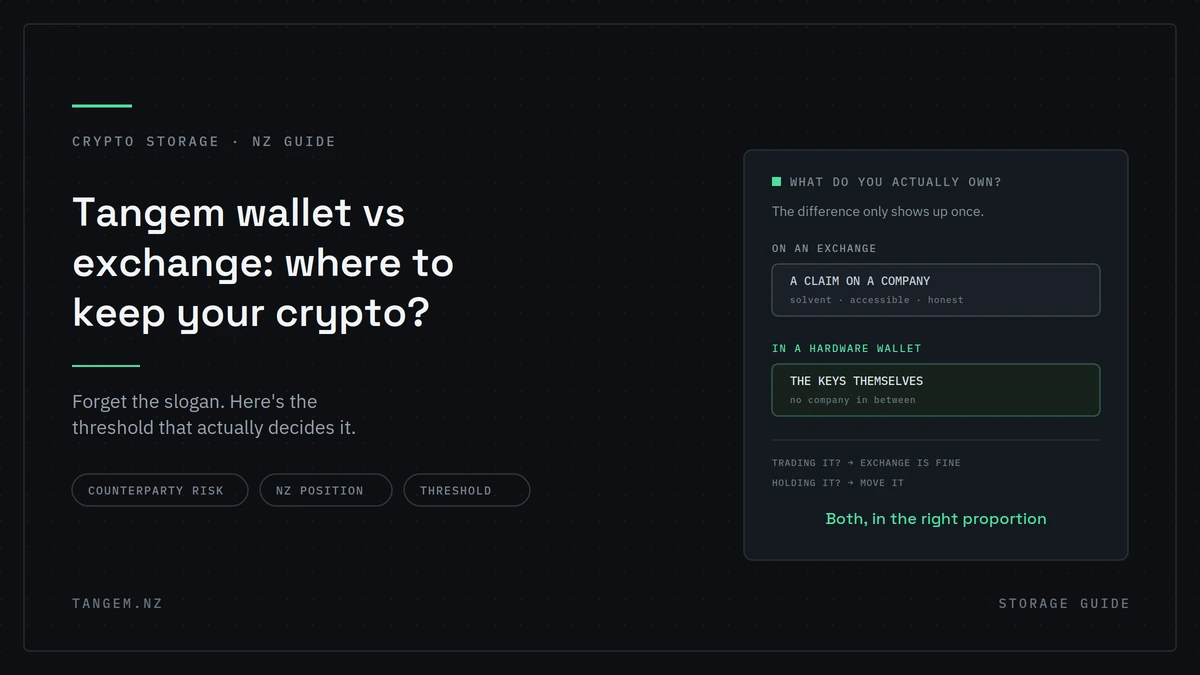
Keep on an exchange what you’re actively trading, plus any amount you’d shrug off losing. Move to a hardware wallet anything you’d be genuinely upset to lose.
Where that line sits is personal. What isn’t defensible is “all of it, indefinitely, on an exchange”, because that’s not a decision. It’s inertia.
What you actually own in each case
The difference isn’t technical. It’s legal, and it only becomes visible when something goes wrong.
Exchange custody is an IOU
Your exchange balance is a database entry recording what the company owes you. The actual coins sit in the exchange’s own wallets, usually pooled with everyone else’s.
That works perfectly well while the company is solvent, honest and operating normally. You’re relying on all three.
Self-custody is possession
With a hardware wallet, the private key exists on your device and nowhere else. The blockchain recognises that key directly. There’s no company in between, no account to be frozen, no balance to be disputed.
If you’re unclear how a wallet without a recovery phrase manages backups, our explanation of how seedless wallets work covers the mechanism.
Why this only matters when something goes wrong
Day to day, the distinction is invisible. You log in, you see a number, you can sell it. Nothing about the experience tells you which model you’re in.
It becomes the only thing that matters during an insolvency, a withdrawal freeze, or an account dispute. By then the decision has already been made for you.
The risks on each side
Both approaches have failure modes. They’re different in kind, and pretending otherwise is how people end up making the wrong choice for their situation.
What can go wrong on an exchange
- Insolvency. The company fails and you become an unsecured creditor in a process that takes years and rarely returns everything.
- Withdrawal freezes. Access suspended during a liquidity problem, an investigation, or a technical failure.
- Account restrictions. Verification issues, a flagged transaction, or a compliance review can lock you out of your own balance temporarily.
- Hacks. Less common at large exchanges than it used to be, but not zero.
- Losing access to your own account. Lost 2FA device, changed phone number, closed email. Recoverable, usually, but slowly.
- Jurisdiction. If the exchange is incorporated overseas, another country’s law governs what happens to your balance.
What can go wrong with self-custody
- Losing every backup device. Unrecoverable, with no support line to call.
- Forgetting your access code. A harder failure than losing a card, because every card in a set is protected by the same one.
- Approving a malicious transaction. Hardware signs what you tell it to sign.
- Sending to a wrong address. Irreversible.
Our guides to what happens if you lose your wallet and protecting your crypto from scams cover both sides of that in detail.
The uncomfortable part
More people lose crypto to their own mistakes than to exchange failures.
That’s worth stating plainly on a page like this. Self-custody transfers risk from a company to you. If you’re not going to store your backups properly or set an access code you’ll remember, an exchange may genuinely be the safer place for your money.
The point isn’t that self-custody is automatically better. It’s better if you do it properly, and the question is whether you will.
The New Zealand picture
Worth understanding, because most content on this topic is written for the US and doesn’t transfer.
Crypto exchanges operating in New Zealand aren’t regulated the way banks are. There’s no deposit guarantee scheme covering crypto holdings, and no equivalent of the protections you’d expect on a savings account.
What protection you actually have
Consumer law applies to how a business treats you, and the exchange’s own terms of service set out what they owe you. That’s not the same as a government guarantee, and it isn’t a substitute for one.
Offshore versus New Zealand-based exchanges
Where the company is incorporated determines whose insolvency law applies to your balance if things go wrong. An offshore platform means an offshore legal process, in another language and time zone, with your claim ranked alongside thousands of others.
Worth knowing which one yours is. It’s usually in the terms of service, and it takes two minutes to find.
Keep your records either way
Moving crypto between wallets you control generally isn’t a taxable disposal, since you haven’t sold or swapped anything. But selling is, and Inland Revenue expects you to be able to show your cost base.
Keep dates, amounts, transaction hashes and NZD values regardless of where you store things. Reconstructing it later is miserable.
The comparison, side by side
| Exchange storage | Tangem hardware wallet | |
|---|---|---|
| Who holds the keys | The exchange | You |
| What you own | A claim against a company | The keys themselves |
| Access speed | Instant, subject to their systems | Tap a card |
| Trading | Built in | Requires moving funds first |
| Upfront cost | None | Cost of the device |
| If you lose access | Account recovery process | No recovery if all devices are lost |
| If the company fails | You’re an unsecured creditor | Unaffected |
| Protection available | Consumer law and their terms | None. It’s on you |
| Best for | Active trading, small balances, NZD in and out | Long-term holdings you’d hate to lose |
Where the threshold sits
Three practical tests. If a holding fails any of them, it probably belongs in self-custody.
The sleep test
Would losing this amount ruin your month? Your year? If the honest answer is yes, it shouldn’t be sitting in someone else’s custody indefinitely.
If losing it would be irritating rather than damaging, an exchange is a reasonable place for it.
The time test
Are you going to trade this in the next three months? If not, it has no functional reason to be on an exchange. It’s sitting there out of habit, carrying counterparty risk in exchange for convenience you’re not using.
The proportion test
What share of your total savings is this? A month’s pay behaves very differently from a year’s. The larger the proportion, the less sense it makes to have it depend on a single company continuing to operate normally.
To be clear: if your holding is small, you’re actively trading, and the exchange is reputable, leaving it there is a defensible choice. Not a moral failure, and not something you need to feel lectured about.
The setup most people should have
Three places, each doing what it’s good at:
- A small exchange balance for buying with NZD, selling, and any trading you actually do
- The bulk in hardware, covering anything you’re holding rather than trading
- A small hot wallet if you use on-chain apps, funded with amounts you’d accept losing
That’s not a compromise between two options. It’s using each for its actual strength.
Why the exchange still has a role
Self-custody doesn’t replace an exchange. You still need somewhere to convert NZD to crypto and back, and hardware wallets aren’t built for that.
Anyone telling you to close your exchange account entirely hasn’t thought about how you’d sell.
What “the bulk” means in practice
Anything you’re not touching this quarter. If you bought intending to hold for years, that’s the portion this applies to, and it’s usually most of what people own.
If you’re going to move it, do it properly
The mechanics matter less than the sequence. Get the order right and there’s very little that can go wrong.
- Set up the wallet and verify that every backup device opens it before any funds are involved
- Send a small test amount first. Yes, it costs an extra withdrawal fee. It’s the cheapest insurance available.
- Confirm it arrives in the wallet app, not just on a block explorer
- Then move the rest, ideally in fewer larger transfers, since withdrawal fees are usually flat
- Check minimum withdrawal amounts before you plan the transfers
Our guide to transferring crypto from an exchange to a cold wallet walks through the process properly, including address verification.
FAQs
Is it safe to leave crypto on an exchange?
For small amounts and active trading, it’s a reasonable trade-off. For long-term holdings, you’re relying on a company remaining solvent, accessible and honest for years. The risk isn’t zero and it isn’t dramatic. It’s just real, and it grows with the amount.
What happens to my crypto if an exchange collapses?
You’d typically become an unsecured creditor in an insolvency process. Recovery takes years, rarely returns everything, and if the exchange is incorporated offshore, it happens under another country’s law.
How much crypto should I keep on an exchange?
Enough to trade with, plus an amount you’d be annoyed rather than damaged to lose. Anything you’re holding for the long term has no functional reason to sit there.
Do I need a hardware wallet for a small amount?
Probably not. If the holding is small and you’re trading regularly, a reputable exchange with strong two-factor authentication is a sensible place for it. The case for hardware strengthens as the amount grows.
Can I still trade if my crypto is in a hardware wallet?
Not directly on an exchange. You’d move funds back first. Many people keep a trading balance on the exchange and the bulk in hardware precisely to avoid shuffling funds constantly.
Are New Zealand crypto exchanges regulated?
Not in the way banks are, and there’s no deposit guarantee covering crypto holdings. Consumer law and the exchange’s own terms are what you have.
Ready to move the long-term portion? Tangem NZ is the authorised New Zealand seller, with stock in Auckland and NZ$ pricing including GST. Set up and verify your wallet first, send a small test transaction, confirm it arrives, then move the rest.