Every guide to self-custody tells you the same thing: write twelve words on paper, guard them with your life, never photograph them, never type them anywhere.
Can You Use a Tangem Wallet Without a Seed Phrase
Yes, you can use a Tangem wallet without a seed phrase, and that’s how it works by default. The more useful question is whether that’s better for you, because it’s a genuine trade-off rather than a free upgrade. This guide covers how the seedless model works, why it removes the most common way people lose crypto, and what you give up in exchange, including the criticism raised in self-custody circles, which is fair and worth taking seriously.
Yes, and it’s the default
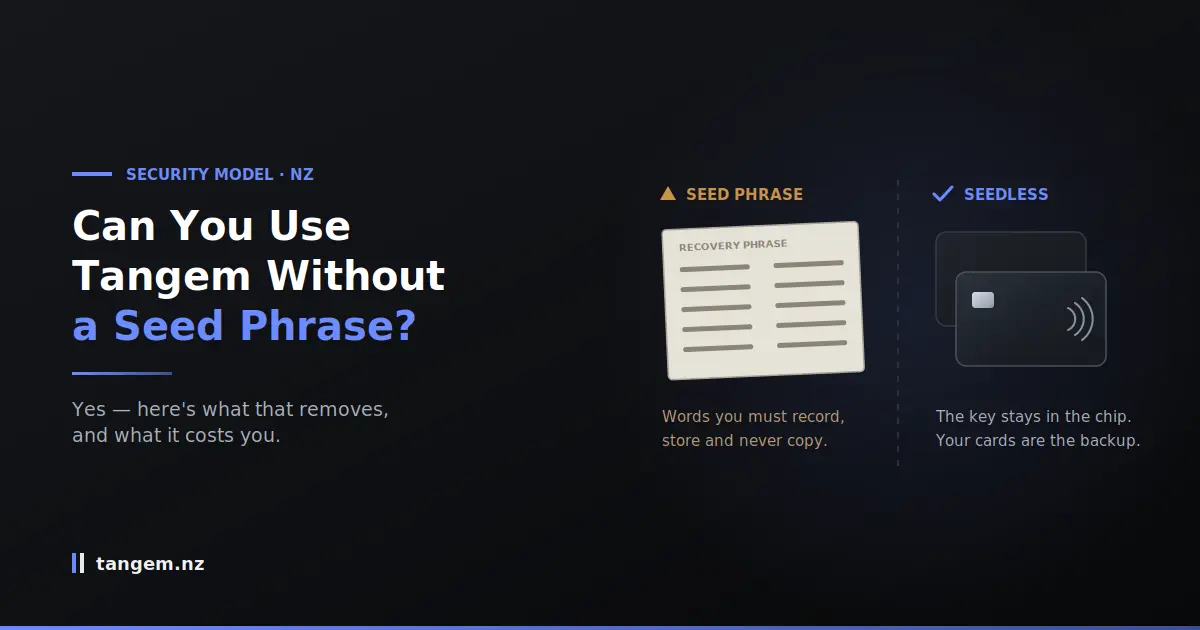
Tangem wallets are seedless out of the box. The private key is generated inside the card’s secure chip during setup and never leaves it, so there’s nothing to write down and nothing to hide. A seed phrase is available as an option if you specifically want one, but it isn’t how the wallet is designed to work.
Your backup isn’t words on paper. It’s the other cards in your set.
How a seedless wallet actually works
The private key is created inside the card’s secure element and copied only to the other cards in your set during setup. It’s never displayed, never exported, and never exists in a form you could write down, photograph or accidentally paste somewhere.
That’s the whole design. Everything else follows from it.
The card is the key
The secure element is a chip built to hold a secret and perform operations with it without ever revealing it. When you sign a transaction, the card does the signing internally and hands back only the signature.
The key never being exportable sounds like a limitation. It’s actually the point: a secret that can’t be extracted can’t be stolen by copying, screenshotting or social engineering.
Your cards are the backup
During setup, the same key is written to each card in your set, two or three cards all holding identical access. Lose one and the others still work exactly as before.
That’s your recovery process. Not typing twelve words into a replacement device, but tapping a different card you already own. There’s nothing to remember and nothing to transcribe correctly under stress.
What the phone does and doesn’t hold
The app is an interface. It displays balances, builds transactions and shows you addresses, but the keys aren’t in it and never pass through it.
Lose your phone and nothing is at risk. Install the app on a new phone, tap a card, and your wallet is there. The phone is a screen, not a safe.
Why seedless is safer for most people
The most common way people lose crypto isn’t a sophisticated hack. It’s a seed phrase problem. Lost, damaged, photographed, stored in the cloud, thrown out during a move, or typed into a convincing fake website. Removing the phrase removes that entire category of failure.
This is the strongest argument for the seedless model, and it’s a behavioural argument rather than a cryptographic one.
The failure modes a seed phrase creates
Every one of these is a real way people have lost funds:
- Paper that burns, floods or fades. Receipt-printer ink on a folded page in a drawer for eight years.
- A photograph “just for now.” Which then syncs to cloud storage automatically.
- A note in the notes app, or an email to yourself, or a password manager entry.
- A visitor who finds it. Or a family member, a tradesperson, a flatmate.
- A phishing site. The most effective crypto theft technique in existence, and it needs you to type the words in.
- Transcription errors. One wrong word, discovered when you actually need it.
A seedless wallet is immune to all six, because there’s no artefact to mishandle.
Phishing has no target without a phrase
Most crypto theft follows the same script. Someone receives a message about a wallet problem, follows a link to a page that looks right, and enters their recovery phrase.
If you don’t have one, that attack has nothing to ask for. An attacker needs physical possession of one of your cards and your access code, which is a much harder problem than tricking someone with a well-designed web page.
What you give up
Without a seed phrase you cannot restore your keys into any other wallet. Your access depends on your Tangem cards and the Tangem app continuing to work. That’s a real constraint, and it’s the criticism raised most often in self-custody communities.
It deserves a straight answer.
No portability to another wallet
With a seed phrase, your keys are portable. Type the words into any compatible wallet (a different brand of hardware device, a software wallet, a recovery tool) and your funds are there. The phrase is a universal format.
Seedless, that door is closed. The key lives in the cards and can’t be moved to a Ledger, a Trezor, or a software wallet. You’re choosing a specific product rather than a portable standard.
What happens if Tangem stops existing
Your cards keep working. They’re not dependent on a server, and the key is already on them, because signing happens on the card itself. And the app is published as open source, which means it isn’t solely dependent on one company’s app store presence.
But you should think this through before committing rather than after. If your threat model genuinely includes “this company disappears and I need to move my keys elsewhere,” a seed phrase is the answer to that specific concern, and Tangem supports one.
Why some people will still want a phrase
Three groups:
- Large single holdings. If a meaningful share of your net worth sits in one wallet, portability may be worth the added risk of holding a phrase.
- Multi-brand setups. If you deliberately spread across different hardware manufacturers, you need a portable key format.
- Anyone whose concern is vendor risk specifically. That’s a coherent position, not paranoia.
If you’re in one of those groups, use the seed phrase option. The wallet supports it.
Seedless and seed phrase, side by side
| Seedless (Tangem default) | Seed phrase | |
|---|---|---|
| What your backup is | Additional cards holding the same key | 12 or 24 words you record and store |
| What an attacker needs | A physical card plus your access code | Only the words, from anywhere in the world |
| Vulnerable to phishing | No phrase to enter | Yes, and it’s the leading attack |
| Portable to other wallets | No | Yes, to any compatible wallet |
| Recovery process | Tap another card | Type the words into a new device |
| Can be lost in a fire or flood | Cards are durable; separate locations help | Paper is fragile |
| Can be accidentally copied | No, the key can’t be exported | Yes: photos, notes apps, cloud sync |
| Inheritance | Cards plus written instructions | Words plus written instructions |
| Suits | Most people, especially first-timers | Large holdings, multi-brand setups, vendor-risk concerns |
Using a seed phrase with Tangem if you want one
Tangem does support seed phrases: you can create one, or import an existing wallet from another device. So you can run it as a conventional hardware wallet if that’s your preference. The important detail is when you make that choice.
The decision point
The general principle regardless: decide your recovery model before you initialise, not after you’ve funded the wallet. Changing your mind later may mean setting up a new wallet and moving funds, which costs network fees and time.
Importing an existing wallet
If you’re coming from another hardware wallet and want to keep your current keys, the import path exists. That’s the sensible route for anyone consolidating devices rather than starting fresh, since you keep your addresses and your history.
What replaces the seed phrase in your planning
The security work doesn’t disappear. It moves. Instead of protecting words, you’re protecting physical cards and an access code, and making sure someone else could find and use them if you couldn’t.
Three things replace the phrase in your planning.
Card storage and geographic separation
Your cards are your backup, so they shouldn’t all live in one place. One accessible, the others somewhere a single burglary, fire or flood couldn’t reach. A relative’s house in another suburb, or a bank facility.
The Tangem NZ range shows how card counts differ between sets, and the card count is the backup decision: two cards versus three changes how much redundancy you have.
Access codes and the one rule that matters
Set an access code, and never store it with the cards. A card in a drawer with the code written beside it is a single object that hands over everything.
Card in one place, code in another place or in your head. That separation is the security model.
Inheritance without a phrase
With no words to write down, inheritance planning changes shape. What someone needs to know is: crypto exists, access requires a physical card plus a code, where the cards are, and that the app is free to install.
Write that down. Store it with your important documents, referenced from your will rather than written into it. Deliberately leave the access code out of it.
Who should choose seedless, and who shouldn’t
Seedless suits you if:
- This is your first move into self-custody
- You’ve lost, damaged, or nearly lost a seed phrase before
- You’re setting up for a household and need something a partner can actually use
- You want recovery to be tapping a card, not transcribing words
- Your realistic risk is your own mistakes rather than a targeted attack
A seed phrase suits you better if:
- A large share of your net worth sits in one wallet
- You deliberately spread holdings across multiple hardware brands
- Vendor dependence is a specific concern you’ve thought through
- You’re already comfortable managing a phrase securely and have been for years
Most people are in the first group. Some aren’t.
Pros and cons
In favour of seedless
- Nothing to write down, lose, photograph or have stolen
- Phishing has no target
- Recovery is tapping a card, with no transcription to get wrong
- The key can’t be extracted from the chip
- Simple enough that a non-technical partner can genuinely use it
Against seedless
- Your keys are not portable to another brand of wallet
- You’re dependent on Tangem’s cards and app rather than an open standard
- Lose every card and the funds are gone permanently
- The choice of recovery model is best made before you initialise, not after
- Some experienced users will consider the trade-off wrong for them, and that’s a legitimate view
FAQs
Does Tangem use a seed phrase?
Not by default. Wallets are seedless: the key is generated inside the card and copied to your other cards as backup. A seed phrase is available as an option if you want one.
What happens if I lose all my Tangem cards?
The funds are unrecoverable. There’s no seed phrase, no company record and no support line that can restore access. This is why the number of cards in your set and where you store them are the two decisions that matter most.
Is a seedless wallet less secure than one with a seed phrase?
It shifts the risk rather than increasing it. You lose portability and gain immunity to phishing and to every way a written phrase can be lost or copied. For most people that’s a favourable trade; for some it isn’t.
Can I move my Tangem wallet to a Ledger or Trezor?
Not if it was set up seedless, because the key can’t be exported from the card. If cross-brand portability matters to you, use the seed phrase option when you initialise.
What happens to my crypto if Tangem goes out of business?
Your cards continue to work, since signing happens on the card rather than on a server, and the app is published as open source. If that scenario is a specific concern, a seed phrase is the direct answer to it.
How do I recover a Tangem wallet without a seed phrase?
Tap any other card from your set with the app installed on any compatible phone, and enter your access code. That’s the entire recovery process.
Ready to go seedless? Tangem NZ is an authorised New Zealand seller, with two- and three-card sets in stock in Auckland and NZ$ pricing including GST. If you’re not sure which set fits, get in touch and we’ll give you a straight answer.