You’ve got three tabs open, forty reviews between them, and every one ends with “it depends on your needs.” Helpful. The Tangem wallet vs Ledger vs Trezor question actually has a clear answer it’s just not the answer most comparisons are looking for.
Tangem vs Ledger vs Trezor
Here’s the shift that matters in 2026: certified secure elements are now standard across all three brands. Arguing about which chip is safest is fighting the last war. What genuinely separates these devices is how you recover your wallet, how you verify a transaction, and what you’re carrying around. Those three things decide which one suits you.
The short answer for most New Zealanders
Tangem if you want the simplest path to self-custody, sign from your phone, and don’t want a written recovery phrase to look after. Trezor Safe 3 if open-source firmware and auditability matter to you it’s the strongest security per dollar at the entry level. Ledger if you hold assets across many chains, use DApps, and want the broadest ecosystem.
None of these is a bad choice. They’re built around different trade-offs, and the wrong one for you is usually the one that doesn’t match how you actually use crypto.
Security is no longer the differentiator
All three brands ship devices with certified secure elements, and that level of hardware protection has become the baseline rather than a selling point. If you’re choosing between current-generation devices from these three vendors, you’re not choosing between secure and insecure.
What all three do identically
- Private keys are generated on the device and never leave it
- Transactions are signed on the device, not on your phone or computer
- An attacker with your email, passwords and even your phone still can’t move funds without the hardware
- None of them protects you from approving a malicious transaction yourself
That last point is worth sitting with. Most people who lose crypto while holding a hardware wallet weren’t hacked they approved something they didn’t understand, or they mishandled their recovery.
Where they genuinely diverge
Four things:
- Recovery model: a written seed phrase, or backup cards
- Firmware: open source or closed, and whether it can be updated after purchase
- Verification: on the device’s own screen, or on your phone
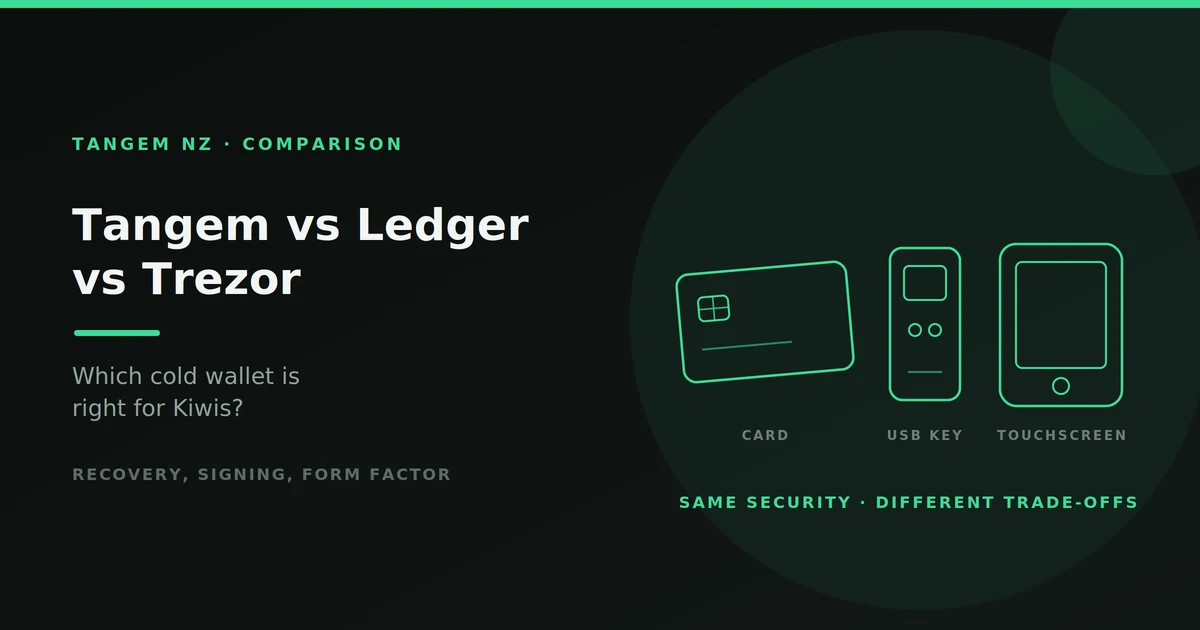
- Form factor: a USB stick, a touchscreen device, or a card in your wallet
Those differences are the whole decision.
The recovery question: seed phrase or card backup
This is the most consequential difference between Tangem and the other two, and the section most comparisons rush past.
Ledger and Trezor generate a 12 or 24-word recovery phrase that you write down and protect. Tangem generates the key on the card itself and backs it up by pairing additional cards typically a set of two or three with no phrase to write down.
Both approaches work. They fail in completely different ways.
The case for a written seed phrase
A standard recovery phrase is portable. It restores your wallet on any compatible device from any vendor, so you’re never dependent on one manufacturer continuing to exist or continuing to sell hardware. Trezor also supports multi-share backup, which lets you split recovery across several locations so no single piece is enough on its own.
If you want maximum independence and you’re confident you can protect a piece of paper for a decade, this is the stronger model. It’s a genuine advantage, and anyone telling you otherwise is selling something.
The case for card backup
The most common way ordinary people lose crypto isn’t a hack it’s a lost, destroyed or compromised recovery phrase. House fires. Floods. Moving flats. A helpful relative clearing out a drawer. A photo taken “just temporarily” that ends up in cloud backup.
Card backup removes that failure mode entirely. Keep one card at home, another somewhere else, and either restores the wallet. Nothing to write, nothing to hide, nothing to photograph.
The trade-off, stated plainly
With a written phrase, your risk is your own storage discipline. With cards, your risk is dependence on one vendor’s ecosystem and on keeping physical cards in separate places.
Pick the failure mode you’re more confident you can avoid. That’s the honest version of this decision.
The comparison
| Tangem | Ledger | Trezor | |
|---|---|---|---|
| Form factor | Card, no battery or cables | USB stick or touchscreen device | USB stick or touchscreen device |
| Recovery | Paired backup cards | Written seed phrase | Written seed phrase, multi-share option |
| Firmware | Closed, fixed at manufacture | Closed source | Fully open source |
| Firmware updates | Not updatable after manufacture | Yes | Yes |
| Verification | On your phone screen | On-device screen | On-device screen |
| Connection | NFC tap | USB, Bluetooth on Nano X | USB |
| Battery | None | None on S Plus, yes on Nano X | None |
| Entry price (intl.) | ~US$50–55 for a 3-card set | Nano S Plus, budget tier | Safe 3, around US$59 |
| Standout | Simplicity and portability | Ecosystem breadth and app support | Open-source auditability |
| Main limitation | Fixed firmware, phone-screen verification | Closed source, 2020 data breach | Fewer assets, desktop-oriented workflow |
When Ledger is the better buy
Ledger’s advantage is ecosystem. It supports the broadest range of assets and integrates with the widest set of apps, which matters if you hold tokens across many chains or interact with DApps regularly. The Nano X adds Bluetooth for people who sign from a phone, and the Stax sits at the premium end with a curved E Ink display that shows full transaction detail on the device itself.
If your crypto life is active staking, swapping, multiple chains, NFTs Ledger’s ecosystem is the most mature of the three, and that’s a real reason to pick it.
The Ledger caveat NZ buyers should know
In 2020, a Ledger customer database was exposed, including purchaser names, email addresses, phone numbers and physical addresses. The devices and funds weren’t compromised the customer data was.
The practical consequences are ongoing: people on that list still receive targeted phishing, including convincing fake “replacement device” offers. For a New Zealand buyer there’s also the plain physical consideration of having a home address on a leaked list of confirmed crypto owners.
This isn’t a reason to write Ledger off. Their hardware security record is strong and the company has invested heavily in it. It is a reason to be careful about where you buy, what you share, and to treat any unsolicited contact about your wallet as hostile.
When Trezor is the better buy
Trezor’s case is transparency. The firmware is fully open source, which means independent researchers can audit exactly what the device does you are not taking a vendor’s word for it. The current Safe generation pairs that openness with a certified secure element, which addresses the main criticism of earlier Trezor models.
The Safe 3 is widely regarded as the strongest security-per-dollar option at the entry level. Trezor also offers multi-share backup for splitting recovery across locations, and clear-signing tools in its desktop suite that translate raw transaction data into readable descriptions before you approve.
If open-source verifiability is something you actually care about rather than something you’ve read is important, Trezor is your device. The trade-off is a workflow that leans desktop-first, which suits fewer people in 2026 than it did five years ago.
When Tangem makes the most sense
Tangem’s design goal is removing friction. The card has no battery, no buttons, no cables and nothing to charge. You tap it to your phone over NFC, approve in the app, and you’re done. Setup takes minutes, and for someone new to self-custody it removes most of the reasons people give up partway through.
The backup model is the real differentiator a second and third card instead of a phrase to protect. For a lot of ordinary users, that converts the single riskiest part of self-custody into something they can actually manage.
The limitations, in the same breath:
- The firmware is fixed at manufacture and cannot be updated. Tangem’s argument is that unpatchable firmware can’t be maliciously altered either. The flip side is real: if a vulnerability were ever found, the response would be new cards rather than a patch.
- You verify transactions on your phone screen, not on the card. The card has no display. Device-screen verification is genuinely stronger, and that’s a point to Ledger and Trezor.
- At least one reviewer’s verdict is that it’s the best card-style wallet but not what they’d use as a sole vault for a large portfolio. That’s a fair position, and worth weighing if you’re securing a substantial holding.
Where Tangem is the clear pick: phone-first users, first-time self-custodians, anyone who wants a wallet they can carry without thinking about it, and anyone who knows a written phrase would be the weak link in their setup.
What this actually costs in New Zealand
International pricing puts entry devices roughly in the US$50–80 band, but that isn’t what a Kiwi buyer pays. Landed cost includes freight, the exchange rate, GST, and two to four weeks of waiting if you’re ordering from offshore.
Importing versus buying locally
Ordering direct from an overseas vendor is straightforward but slower, and a warranty issue means dealing with a company on the other side of the world. Buying from a New Zealand seller means GST is handled, shipping is domestic, and support is reachable.
There’s also the delivery consideration raised above fewer parties knowing that a crypto hardware device is going to your home address is not a trivial benefit.
Never buy used, discounted or from a marketplace listing
This applies to all three brands equally, and it’s the one rule with no exceptions.
The attack is simple: a seller sets up the device, records the keys, repackages it, and waits for you to fund it. A device that arrives with a recovery phrase already written on the card or sheet is the clearest possible sign of it a legitimate device generates its keys during your setup, in your hands.
Buy sealed, from the manufacturer or an authorised local seller, and verify the packaging as the vendor instructs. You can see the authorised NZ range at Tangem NZ.
How to choose, in three questions
1. Do you want a written recovery phrase? Yes → Ledger or Trezor. No → Tangem.
2. Do you sign from your phone or a computer? Phone → Tangem, or Ledger Nano X for Bluetooth. Computer → Trezor or any Ledger.
3. How many assets and chains do you hold? A handful of major ones → any of the three. Dozens across many chains, plus DApp use → Ledger.
If those three answers point at the same device, you’re done. If they conflict, question one wins recovery model is the thing you’ll live with longest.
FAQs
Which is safest: Tangem, Ledger or Trezor?
All three use certified secure elements and keep keys off the internet. The meaningful differences are recovery model, whether firmware is open source and updatable, and whether you verify on the device or your phone not raw chip security.
Can I use a hardware wallet without a seed phrase?
Yes. Tangem generates keys on the card and backs up to additional paired cards instead of a written phrase. Ledger and Trezor both use standard recovery phrases.
What happens if the company goes out of business?
With a standard seed phrase, you restore your wallet on any compatible device from another vendor. With a card-based system, you depend on having your backup cards which is why keeping them in separate locations matters.
Is Ledger still safe to use after the 2020 data breach?
The breach exposed customer contact details, not device security or funds. The hardware remains well regarded. The lasting effect is targeted phishing aimed at people on that list, so treat unsolicited wallet-related contact with suspicion.
Do I need the three-card Tangem set, or is two enough?
Two gives you a backup. Three lets you keep one at home, one elsewhere, and still hold a spare sensible if losing access would be serious for you.
Which hardware wallet is best for a beginner in New Zealand?
Whichever you’ll set up and recover correctly. Tangem has the shortest path from box to first transaction; Trezor Safe 3 is the best-value traditional device. A more advanced wallet isn’t safer if it’s mishandled.
Can I use more than one brand?
Yes, and some people do a card for everyday amounts, a separate device as a long-term vault. They’re independent wallets, not a single account.
The bottom line
Stop comparing chips. In 2026 all three of these brands make secure hardware, and the decision comes down to three things: whether you want a written phrase or backup cards, whether you sign from a phone or a desk, and how complicated your portfolio is.
Tangem wins on simplicity and on removing the recovery-phrase failure point. Trezor wins on open-source transparency and entry-level value. Ledger wins on ecosystem breadth. Buy the one that matches how you’ll actually behave, not the one with the longest spec sheet.